
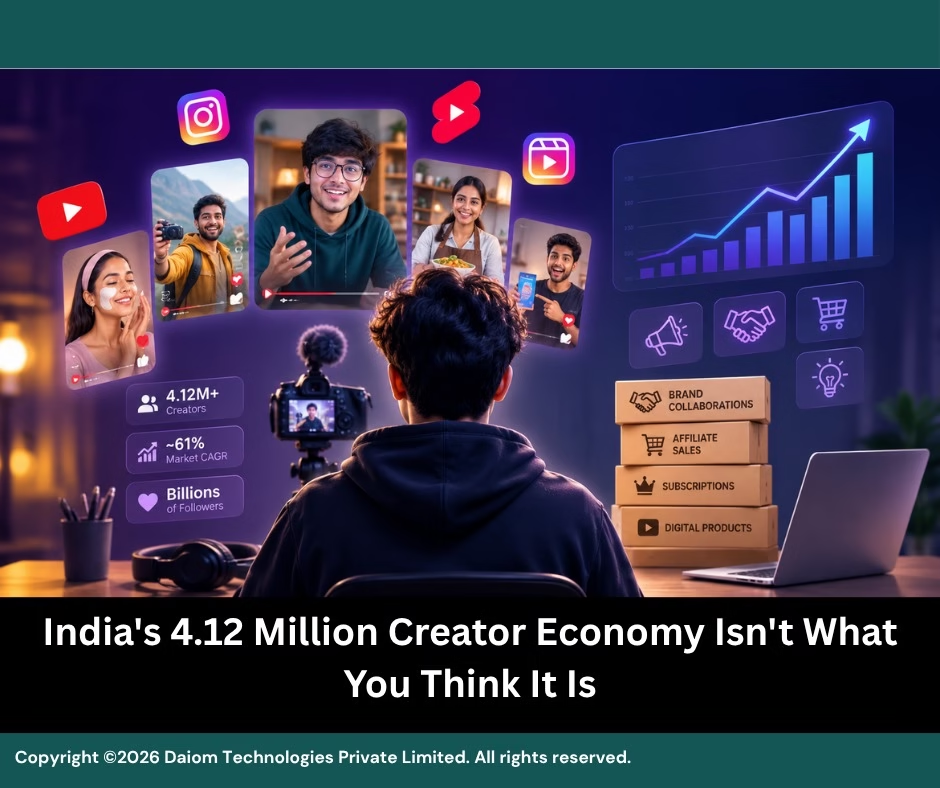



Influencer marketing has become a non-negotiable part of every brand’s playbook, and the market is growing in leaps and bounds.
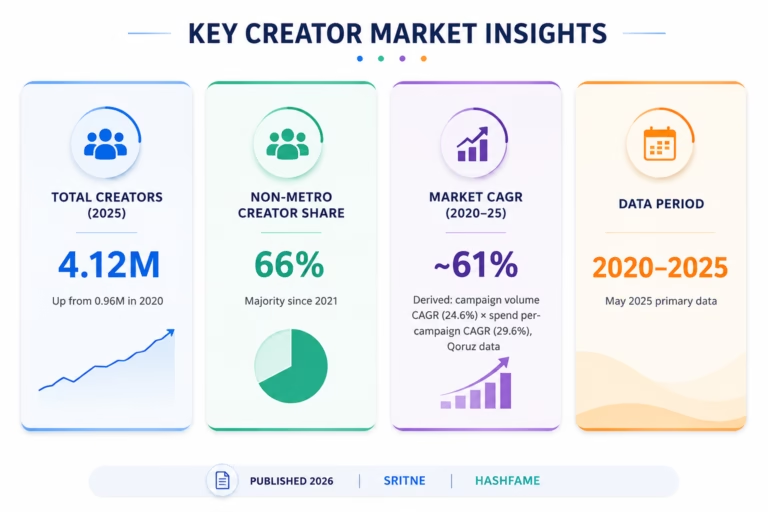
India went from 0.96 million creators in 2020 to 4.12 million in 2025.
But ask most brands about the actual results, and the excitement fades fast.
Now here’s the reality: two out of three Indian creators don’t live in a metro at all. They’re in Varanasi, Rajkot, Guwahati, Madurai..smaller cities and towns most brand campaigns never think about. And they’ve been the majority since 2021.
That’s when I came across the report by ISB’s SRITNE (led by Prof. Madhu Viswanathan), done in partnership with Hashfame. After going through it, we realised it’s the most honest look at India’s creator economy yet.
That’s just one of the findings from a landmark study by ISB’s Srini Raju Centre for IT and the Networked Economy (SRITNE) and Hashfame, which analysed creator, campaign, household expenditure, and labour market data from 2020 to 2025. I went through the full report, and honestly, it dismantles almost every lazy assumption we carry about this industry, including a few I’ve had to unlearn myself while running campaigns.
Let me walk you through what stood out, and why it matters whether you’re a brand, a marketer, or a creator yourself.
1. How Big Has This Market Actually Become?
In 2020, India had roughly 0.96 million creators. By 2025, that number hit 4.12 million.
But the growth story isn’t the interesting part. The geography is.
In 2020, the eight big metros: Mumbai, Delhi-NCR, Bengaluru, Hyderabad, Chennai, Kolkata, Pune, Ahmedabad accounted for 56% of all creators. By 2025, non-metro creators made up 66% of the base, about 2.72 million people.
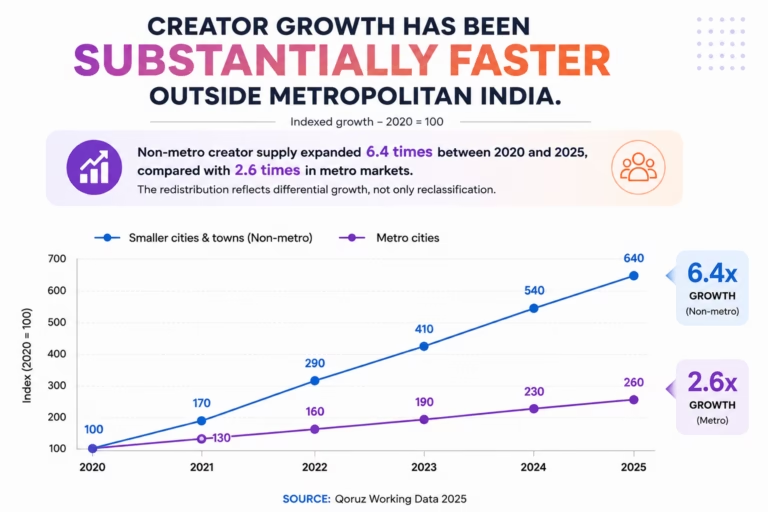
Non-metro creator supply grew 6.4 times over five years, compared to just 2.6 times in metros.
Creator participation is distributed across multiple state markets.
Uttar Pradesh and Maharashtra are large contributors, but the long state tail indicates that creator formation is occurring across a broader set of markets.
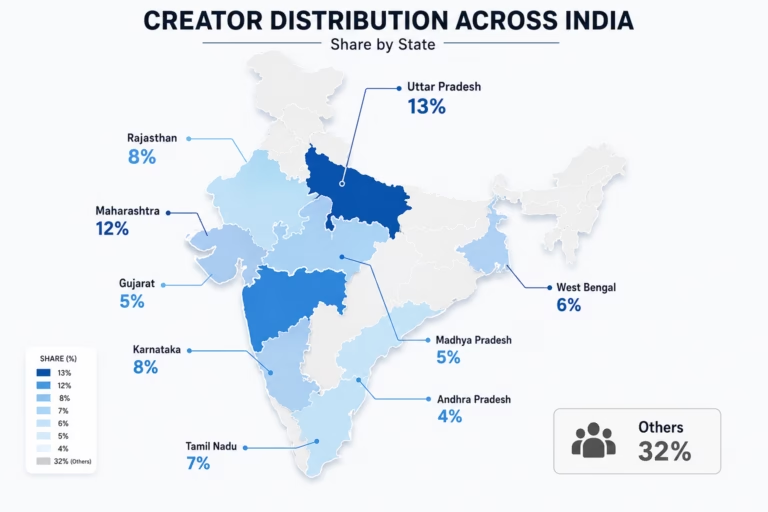
Read that again. The creator economy didn’t grow by getting deeper in Mumbai. It grew by getting wider across Bharat.
And before you assume this diluted quality, it didn’t. Which brings me to the most counterintuitive finding in the entire report.
2. How Did Engagement Go Up When Creator Supply Quadrupled?
Basic logic says: when supply quadruples, attention gets fragmented and average engagement falls. Every saturated digital market follows this pattern.
India didn’t!
Average engagement rates rose from 1.8% in 2020 to 7.2% in 2025, a fourfold increase, at the same time the creator base grew more than fourfold. The audience market expanded alongside the creator market.
Why? Largely because of who the new creators are. Non-metro creators consistently out-engage their metro counterparts across the entire distribution, not just a few outliers. They operate closer to their communities: same city, same language, same cultural references. Their audiences aren’t following a distant celebrity; they’re following someone who feels like a neighbour.
The creators, and notice where they’re from:
- Sourav Joshi: vlogs out of Haridwar, not Mumbai, and became one of India’s most-watched YouTubers
- Village Cooking Channel: a family cooking on open fires in rural Tamil Nadu, with an audience most Bollywood channels dream of
- Manoj Dey: built his massive tech-and-vlogging following from Dhanbad, Jharkhand
- Khan Sir: teaches from Patna in raw, Bihari-flavoured Hindi and fills stadiums
- Round2Hell: comedy trio out of Moradabad, UP
- Crazy XYZ: experiments channel from small-town Rajasthan
- Kabita’s Kitchen: turned simple Hindi home cooking into a media empire
- Dolly Chaiwala: went from a Nagpur tea stall to global virality and brand collaborations
Not one of these stories starts in a metro. Every one is built on exactly what the report describes: language, community, and social proximity.
The brands, and what they figured out early:
- Mamaearth: scaled by activating thousands of nano and micro creators instead of betting everything on celebrities
- Meesho: built its entire growth engine on vernacular, Bharat-first creators talking to tier-2 and tier-3 shoppers
- Purplle: targets beauty buyers in smaller cities through regional voices (sitting right on top of the “parlour paradox” we’ll get to)
- Groww, CRED, PhonePe: lean on finfluencers to simplify products for first-time users in smaller towns, which is exactly why FMCG, e-commerce, and BFSI together account for over half of India’s creator campaigns
The playbook isn’t theoretical. It’s already running. The report just gives it numbers.
I’ve seen this play out first-hand. We worked with a home furniture brand, and while studying their influencer data, we came across something that changed how I think about this space: the assumption that only celebrities and mega influencers can give you the highest ROAS is simply not true.
In the actual numbers, nano and micro creators generally delivered more ROAS, because their audience feels genuinely connected with them. When someone with 8,000 followers recommends a sofa or a study table, it lands like advice from a friend who actually owns it, not a paid promotion. The trust does the selling.
So the lesson for brands is sharper than “tier-2 is cheaper.” Non-metro and smaller creators aren’t a budget alternative to metro influencers. For many categories, they’re a performance upgrade.
3. Why Do Nano Creators, Not Celebrities, Run This Economy?
Here’s the structure most people miss: over half of non-metro creators are nano creators (1,000–10,000 followers), and another 28% are micro creators (10,000–100,000). Together, that’s more than 80% of the non-metro base.
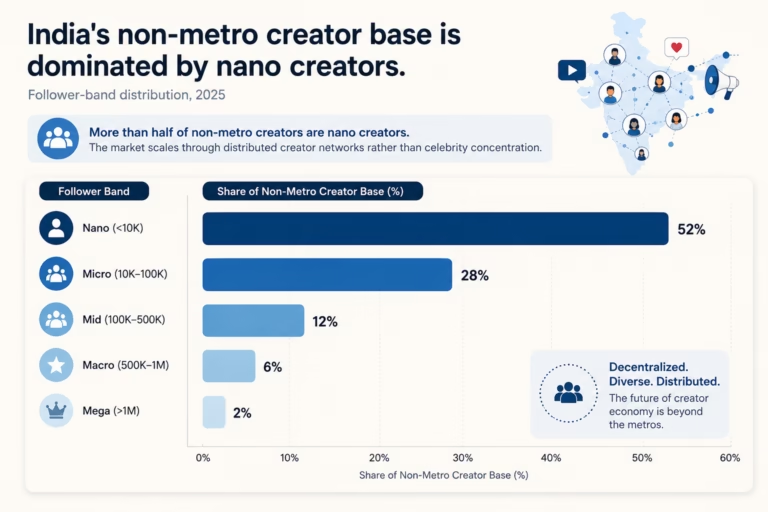
India’s creator economy isn’t a pyramid with a few mega-influencers at the top doing the heavy lifting. It’s a vast, distributed network of small, trusted voices, each one plugged into a specific locality, language community, or interest cluster.
This matches what our furniture brand data showed us too, the value doesn’t come from reach alone. It comes from social proximity and trust. A large portfolio of nano creators gives a brand access to hundreds of small, tight communities that no single celebrity can reach authentically.
4. Is Anyone Actually Making Money Here?
Participation has exploded. Earning hasn’t. The report walks through it in a clean order: supply, engagement, monetisation — and once you read it that way, the picture snaps into focus.
- Non-metro creators reshaped the supply base. Between 2020 and 2025, non-metro creator supply grew 6.4x versus 2.6x in metros. Non-metros went from 44% to 66% of the base. The market didn’t get deeper in Mumbai, it got wider across Bharat.
- Engagement rose even as supply quadrupled. Average engagement climbed from 1.8% to 7.2%, a fourfold jump alongside a fourfold rise in creators. Non-metro creators consistently out-engage metros because they operate closer to their audiences: same city, same language, same references. Audience quality rose with supply, not against it.
- Nano creators dominate participation, but not monetisation. Activated creators grew from 38,000 to 408,000, but the campaign-to-creator ratio fell from 0.37 to 0.10. Most do exactly one campaign a year. Metro creators, meanwhile, improved their repeat rate from 0.22 to 0.33. The starkest number in the report: about 85% of non-metro creators complete zero campaigns in a year. Content creation is still audience-building, not income.
So Is Creator Income Even Real?
Here’s where the report gets smart, it compares creator earnings to local alternatives, not metro salaries.
A nano creator with two campaigns a year earns ~₹5,000/month, about 29% of the average rural wage. At five campaigns, that jumps to 73%. A micro creator at five campaigns hits 147%, genuinely beating a full-time local salary.
Only 2.1% of non-metro creators cross that five-campaign line today. But that’s the entire game. One extra campaign per creator per year would change the economics for hundreds of thousands.
And the supply will keep coming, 46% of young people outside metros have secondary or higher education, 22% are graduates, and local labour markets can’t absorb them at matching wages.
Content creation is a low-entry-cost option in towns where the wage ladder is broken. That’s not an aspiration. That’s economics.
5. What If Language, Not Geography, Is the Real Market Boundary?
Here’s a stat that should redraw every media plan in the country: Hindi accounts for just 42% of India’s creators. Regional languages: Telugu, Tamil, Kannada, Marathi, Bengali, Malayalam, Gujarati, Bhojpuri…collectively hold 58%.
India isn’t one creator market with regional flavours. It’s a portfolio of language markets, each with its own supply, trust dynamics, and campaign intensity.
And some of them are wide open. The report flags Bhojpuri and Kannada as significantly under-monetised, high creator supply, low campaign activity. That’s not weak demand; it’s a discovery failure. Brand teams planning in Hindi and English simply never find these creators. First movers in these language markets are buying engagement at a discount.
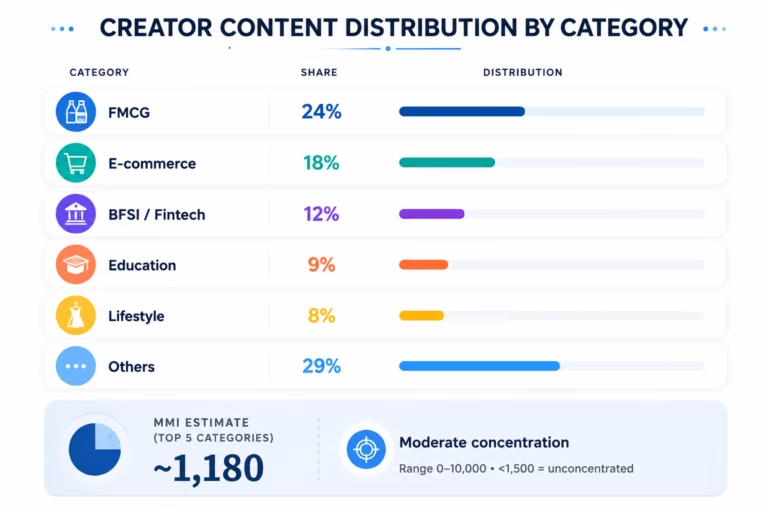
FMCG, e-commerce and BFSI together account for more than half of influencer campaigns in India. The concentration is consistent with the economics of these categories.
- FMCG brands benefit from repeated exposure and ambient recall.
- E-commerce platforms use creators for discovery and conversion.
- BFSI brands, especially in fintech and insurance, use creators to simplify products for first-time users in smaller cities and towns.
Campaign activity is concentrated, but not dependent on a single category.
6. What Are Indian Households Actually Spending On?
The report’s “brand wallet”, median monthly household spend on cosmetics, salon services, snacks, and eating out.. ranges from ₹320 in rural Bihar to ₹1,620 in rural Haryana. A fivefold gap within rural India. The rural/urban binary that most campaign planning still uses is basically useless; the real planning unit is the state-language-category cluster.
Two gems from this section. Personal care holds steady at ~5.3% of household spend across every income quintile, making beauty the most resilient category for creator-led commerce, even in low-income markets. And my favourite, the “parlour paradox”: in many states, rural households are more likely to have visited a parlour than to subscribe to OTT. Beauty creators aren’t creating new demand, they’re digitising spending behaviour that already exists offline.
7. So What Should You Actually Do About All This?
If you’re a brand:
- Stop selecting creators, and start designing portfolios balanced across geography, language, and tier
- Use state-level household data, not gut feel, to allocate budgets
- Build repeat relationships, test 3–6 month partnerships instead of one-off activations
- The depth gap is your arbitrage
If you’re a platform:
- Fix discovery in vernacular markets
- Obsess over moving creators from one campaign to two
- One extra campaign changes a creator’s economics more than any feature launch
If you’re a creator:
- You don’t need a million followers, the data is oddly liberating
- Be genuinely embedded in a community, in your own language
- Pick a category where household money already flows
- Chase repeat brand relationships, not viral moments
8. Where Does This Leave Us?
The first phase of India’s creator economy proved that participation could scale, from under a million to over four million people in five years, most of them far from any metro.
The next phase won’t be about adding creators. It’ll be about productivity: converting the 85% who earn nothing into the 2% who earn meaningfully. The report calls the creator economy a “market institution” in the making, and that framing feels right. This is no longer a social media trend. It’s demand infrastructure for the Indian economy, being built one nano creator at a time.
The brands, platforms, and policymakers who understand that shift early will own the next decade of it.
The first phase of India’s creator economy demonstrated that participation could scale. The next phase will determine whether participation can translate into sustained productivity and long-term economic opportunity.SRITNE x Hashfame Creator Economy Structural Analysis, 2026
Source: This blog is based on “India’s Creator Economy: A Structural Analysis of Supply, Engagement, Monetisation, and Economic Opportunity” (2026), published by SRITNE (Srini Raju Centre for IT and the Networked Economy) at the Indian School of Business, Hyderabad, in collaboration with Hashfame — authored under the leadership of Prof. Madhu Viswanathan, Associate Professor of Marketing and Executive Director, SRITNE, ISB.