



Growing up, when someone said shoes, Bata was the first name that came to mind.
Then came the Nike, Adidas, and Puma phase. And over the last few years, we’ve seen a wave of D2C brands enter the market, each with its own story and promise.
But one problem never really went away. Buying shoes online is still hard. You can look at all the photos and read every review, but you still don’t know how they’ll fit or whether they’ll actually be comfortable.
I think that’s one of the biggest reasons so many footwear brands eventually started looking at offline stores. Not because they wanted to, but because customers needed that experience.
A lot of brands gave it a shot. Some opened a handful of stores and shut them down before they could really scale.
Neeman’s, though, feels different.
I’ve been following the brand for a while now, and the way they’ve approached omnichannel is genuinely one of the more interesting retail stories I’ve seen in recent years.
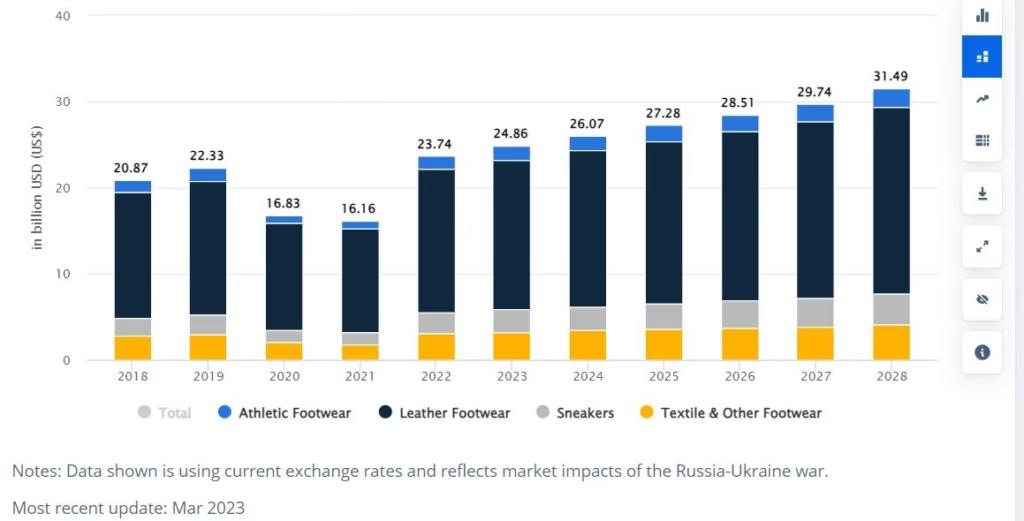
The India footwear market size reached USD 20.67 Billion in 2025 and is projected to reach USD 47.53 Billion by 2034, exhibiting a CAGR of 9.7% during 2026-2034.
And Neeman’s has carved out a distinct spot in it.
Not because of the sustainability angle, that gets talked about enough. But because of something less obvious: they built a genuinely functional omnichannel engine without any of the noise that usually comes with it. No flashy super app, no complicated tech stack announcement, no “we are now omnichannel” press release.
They just quietly connected the dots between where their customers were discovering them and where those customers actually wanted to buy.
We have worked with them closely on parts of this journey, and that has given us a front-row view into how the pieces fit together. So this is less a case study written from the outside, and more what I have actually observed happening.
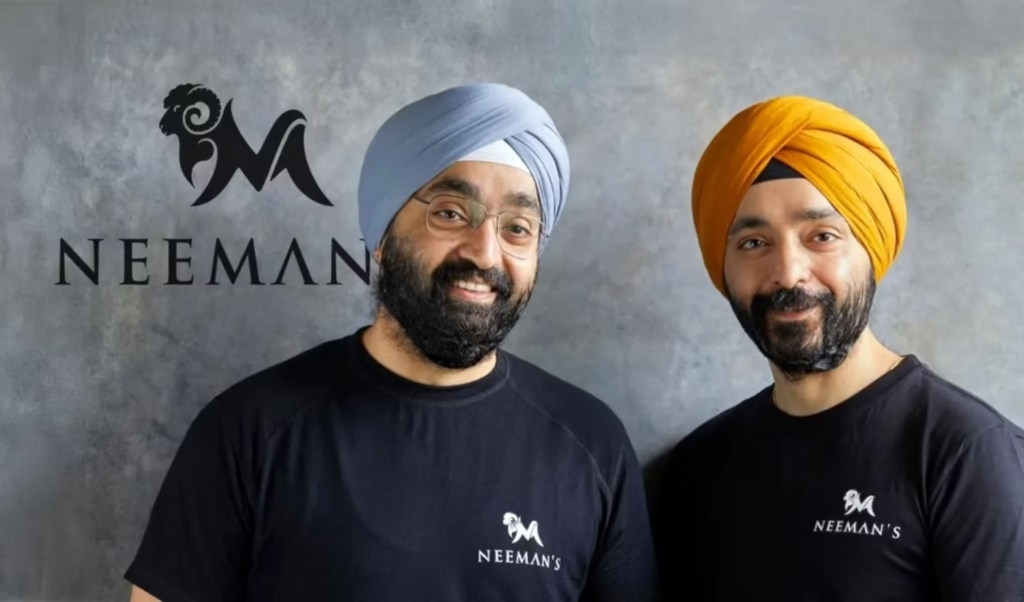
“I’m crafting shoes that pamper your feet and the planet.” — Taran Chhabra, Founder & CEO, Neeman’s
1. The Idea That Started Neeman’s
India is the second largest footwear producer in the world, representing 13% of global footwear production and 2.2% of global exports, with the sneaker segment driving much of that growth, valued at US$21 billion on its own.
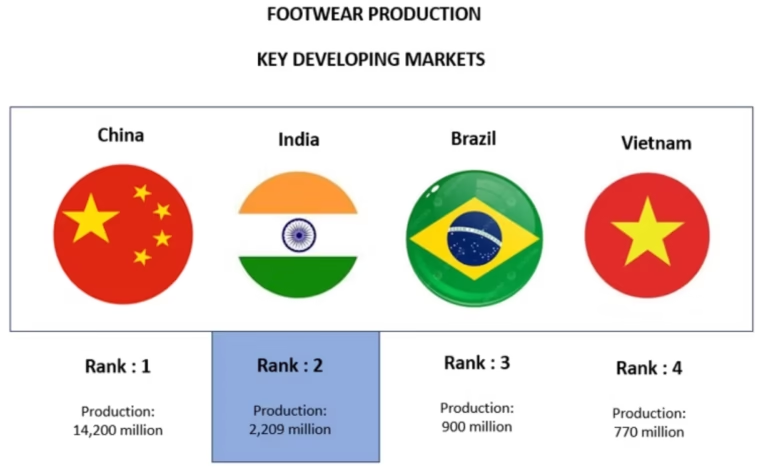
Neeman’s stepped into this space betting that comfort and sustainability could win over a market long dominated by legacy players.
The brand was founded in Hyderabad in 2017 by Taran Chhabra (CEO) and Amar Preet Singh (COO). Taran spent his early career in New Jersey as a business analytics leader in pharma and life sciences, while Amar brought years of business operations experience to lead the backend, supply chain, and execution muscle needed to scale a D2C brand from scratch.
The name Neeman’s is a portmanteau combining Neelam (the founder Taran Chhabra’s mother) and Manjeet (his father).
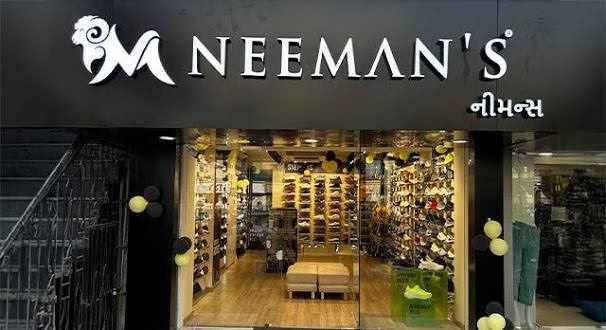
Neeman’s has raised roughly $19.4 million in total, across multiple rounds. Their most recent raise was a $4 million (~₹35.5 crore) Series B2, earmarked for expanding their physical store footprint and scaling operations, a signal that the next chapter of the brand is firmly omnichannel, not online-only.
Neeman’s began with a simple frustration. Why do we need different shoes for different parts of our day?
Founder Taran Chhabra wanted one shoe that could handle work, travel, and casual outings. Comfortable, minimal, made with natural materials. That was the whole idea.

Since launching in 2017-2018, they have sold over 4 million pairs and expanded into apparel and accessories. Their catalog runs into hundreds of styles:
- Sneakers
- Slip-Ons & Clogs
- Sandals & Slides
- Loafers & Oxfords
- formal shoes
- Boots
for every occasion. But what interests me is not the growth number. It is the fact that as they grew, they never let their channels become a scattered mess.

Website. App. Marketplaces. And now a fast-growing offline footprint. All layered into one coherent system, not a loose collection of touchpoints that happen to carry the same logo.
That is harder than it sounds. Most brands add channels, but very few connect them.
“Founded in 2017, Neeman’s targeted omni-channel expansion, offline retail growth, and disciplined profitability amid footwear market tailwinds.”
2. Why Is Neeman’s Selling Across Every Channel?
Neeman’s started as a classic DNVB (Digitally Native Vertical Brand). Website first, performance marketing driven, online only. Great for scale in the early years, until the ceiling shows up.
And in footwear specifically, that ceiling shows up faster than in most categories.
Here’s the uncomfortable truth every online shoe brand runs into: return rates on footwear are among the highest in D2C. Fit, comfort, and material feel are things you simply can’t judge from a product photo. Customers order two sizes, keep one, send one back. Or worse, they try, don’t like the feeling, and return the whole order. Every return burns margin twice: reverse logistics on the way back, and a customer who now trusts the brand a little less.
Physical stores flip that equation. A customer who tries a pair in-store and walks out with them almost never returns. Fit is validated before the sale, not after. The margin protected on a single avoided return often pays for the store visit itself.
That’s why Neeman’s made a deliberate call to build a real brick-and-mortar presence to scale beyond what D2C performance marketing alone could deliver. Not as a pivot away from digital, but as the second leg the business needed to grow profitably. Online drives discovery and demand. Offline closes the sale with confidence and locks in the customer.
For footwear, omnichannel isn’t a strategy choice. It’s a margin choice.
Look at where Neeman’s is today:
Own website → still the brand’s core engine and the majority of its business. Full catalogue, brand storytelling, and first-party customer data that no marketplace gives you.
Marketplaces → Amazon, Flipkart, Myntra. Meet the customer where they already shop.
Quick commerce → live on Zepto, with more platforms coming. Sustainable sneakers delivered in minutes — that’s discovery and convenience in one move.
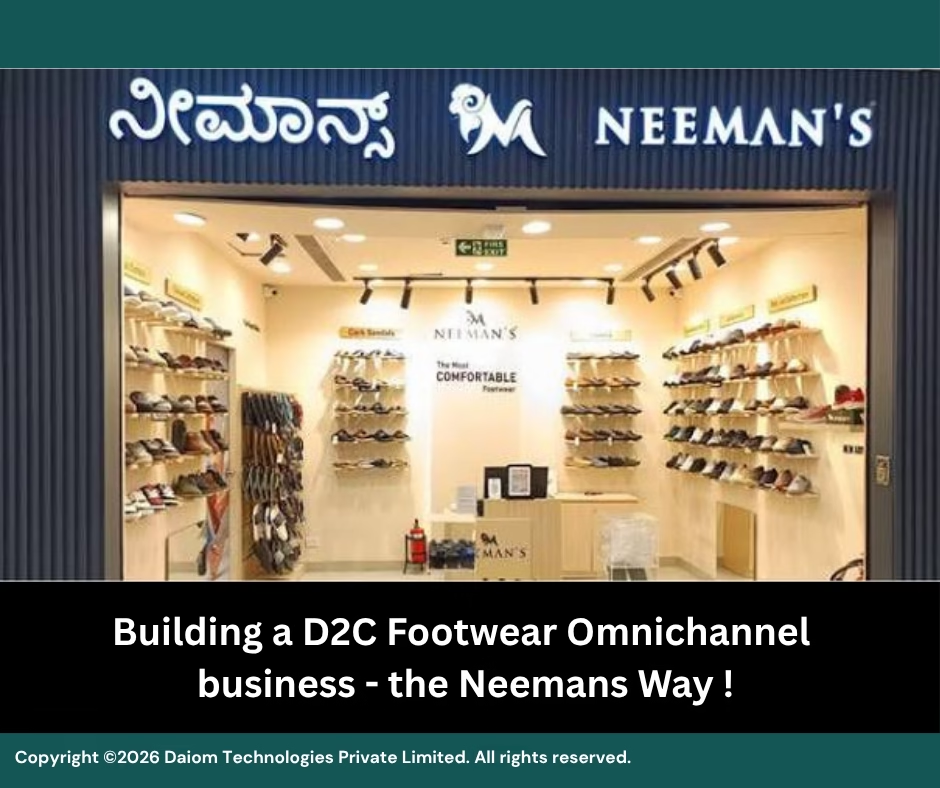
Offline → entered retail in mid-2023. 18 exclusive stores in 24 months. And they have moved fast. In June 2026 alone they added two exclusive stores in Sri Ganganagar and Visakhapatnam, on top of existing locations in malls like Phoenix, Lulu, and Nexus.
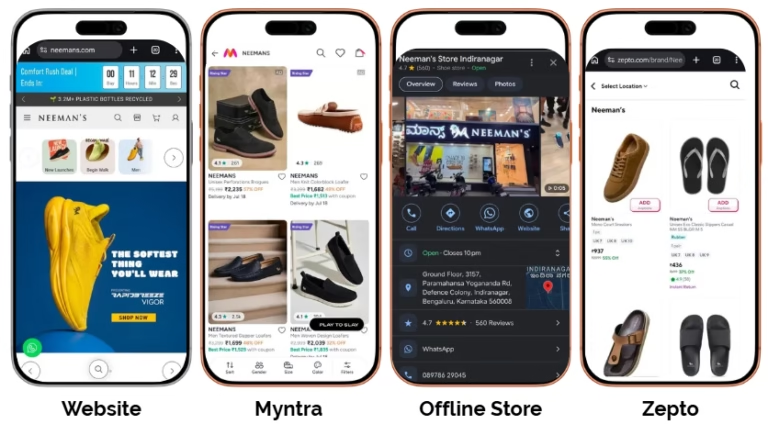
Offline expansion only succeeds when customers can easily find nearby stores. One of the biggest challenges for offline brands isn’t opening stores—it’s getting customers to discover and visit them. Neeman’s addressed this by making store discovery a core part of its digital experience.
By making the store locator genuinely visible and searchable rather than burying it in the footer, Neeman’s improved local SEO for exactly the queries that matter, “Neeman’s store near me,” “sustainable shoes near me,” city-specific searches.
The lesson for every D2C brand: omnichannel isn’t opening stores. It’s making sure a customer can discover you on Instagram, try you in Vizag, buy you on Zepto, and return you anywhere, without ever feeling the seams.
That’s how a DNVB becomes a brand.
3. How Does Neeman’s Market Without Just Buying Attention?
From product drops to marketing campaigns, Taran fronts Neeman’s himself. That founder-led visibility turns every ad into a conversation, not a pitch. In a crowded D2C space, a founder who shows up builds a brand faster than a media plan ever could.

Neeman’s grew up on performance marketing. What has changed is that they have matured into something far more sustainable.
They now run 360-degree communication across email, SMS, push notifications, and in-app messaging, orchestrated across different stages of the customer journey rather than blasted at everyone simultaneously. Someone who browses on the website can be nudged later via app push with something contextually relevant. Not a generic promotion. Something that actually connects to what they were looking at.
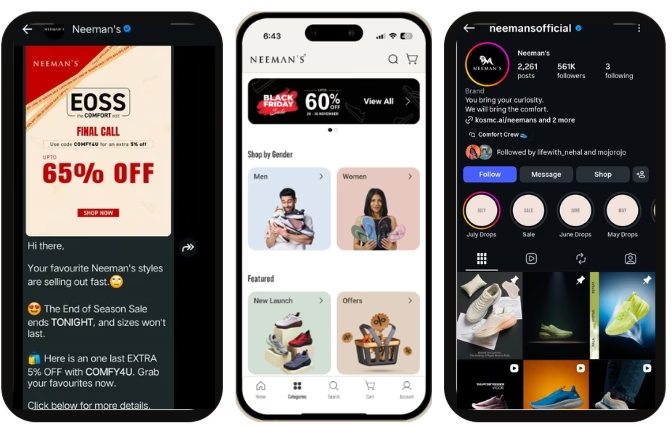
The app has become central to this. It is not just a transactional interface — it is where the entire lifecycle compresses into one place. New drops. Personalised suggestions. Exclusive offers.
And after focusing campaigns around the app, they saw impressions grow roughly 3x within three months.
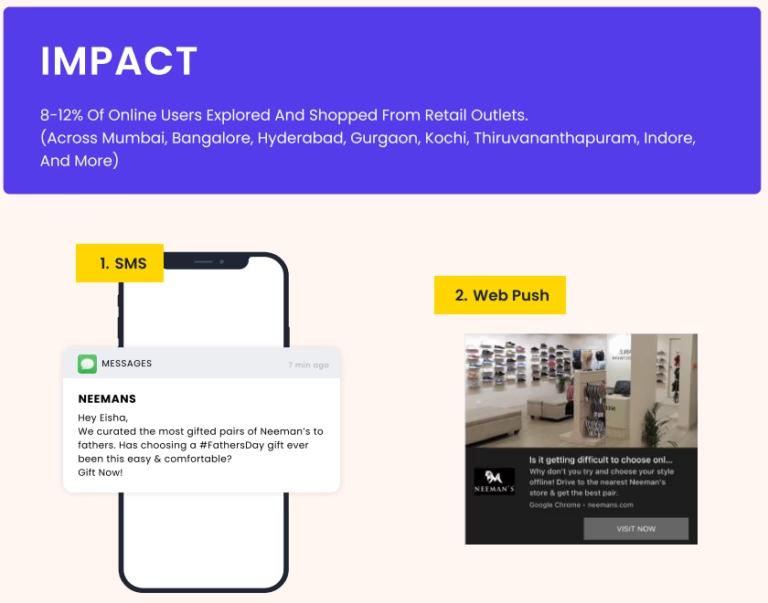
That number matters. But what it signals matters more:
→ The app became the primary canvas for experimentation — testing creatives, timing, and segments
→ Owned channels reduced dependence on paid media, improving both efficiency and long-term retention
→ Every impression sat closer to an action, because it lived inside a commerce environment
For any D2C brand, this is the shift worth studying. Once you have basic traction, an app plus orchestrated communication amplifies reach far more sustainably than just pushing more budget into ads.
4. What Makes the Neeman’s Experience Feel Effortless?
This is where Neeman’s quietly does the most right.
Whether you land on their website, open Myntra, scroll Zepto, or walk into a physical outlet — you hear the same idea. Minimal, multi-use, comfortable, responsible footwear. That consistency becomes a mental shortcut for the customer.
But the experience piece I find most interesting is the online-to-offline handoff.
Footwear journeys almost always start online. Research, reviews, styles, comparison. But they very often complete offline, because fit and comfort are things you have to feel.
Neeman’s has been built for exactly that journey. Browse the full catalogue on the website. Discover the nearest store in a tap. Walk in and try the pair you already shortlisted. And if you change your mind, buy online and return in-store, or buy in-store and return online. The channels don’t just coexist; they hand the customer to each other.
It bridges “I like this shoe” with “I am going to try it on”, and then removes every reason to hesitate after that.
For the customer, this feels like the brand understands both their online behaviour and their offline needs. No digging through menus. No channel walls. No friction at the exact moment they were ready to act.
That is what a good experience actually looks like. Not features. Just fewer reasons to give up.
5. Omnichannel lessons from Neeman’s
Neeman’s omnichannel play works because they respect three simple truths.
Sales — they built a network that does not privilege one channel over another. Customers pick their comfort zone.
Marketing — they treat it as an ongoing relationship, not a one-time performance spike. Lifecycle over acquisition.
Experience — remove friction, tell one story everywhere. Same narrative from homepage to store shelf.
The quiet heroes in this story are the app and the store locator. Two things that are not particularly glamorous, that nobody puts in a press release, and that most brands treat as an afterthought.
But together they turned scattered touchpoints into an actual journey. They amplified reach without amplifying spend. And they pushed online visitors into offline stores — which is exactly where footwear brands close their strongest sales.
6. The Takeaway
As omnichannel goes from being a differentiator to being the baseline, Neeman’s is a good reminder that you do not need a flashy super app or a complex CDP stack to win.
Sometimes it is just about making sure that when a customer likes your shoes online, they can find your store offline, easily, locally, in one tap.
That is not a strategy anyone will build a keynote around.
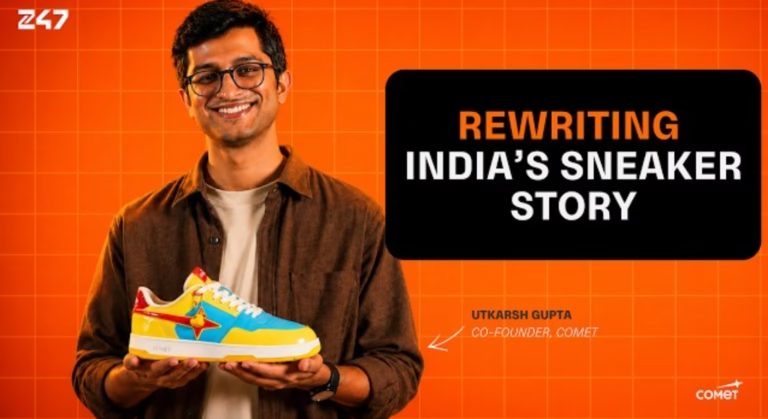
But it works. And it is worth watching how newer players like Comet and Bacca Bucchi approach this same problem, because the next interesting chapter in Indian footwear D2C is probably going to be written right here.
If you are thinking about how to connect your online demand to your offline footprint, we would be happy to think it through with you. Reach out at alibha@daiom.in. For more brand deep-dives and omnichannel insights, follow DAiOM.