



A few days back I was craving something sweet, close to midnight. I opened an app, and twelve minutes later a dark chocolate bar was at my door, in as good shape as if I’d walked to the store for it myself. Gifts, groceries, most other things I’ve ordered on quick commerce, same story, no complaints.
Ice cream is the one exception. I’ve ordered it a few times and it’s shown up half melted and refrozen often enough that I’ve quietly stopped expecting much from frozen desserts on these apps.
Ten years ago that craving would have gone nowhere anyway. It passes, nobody sells anything, and by morning I’ve forgotten about it.
Redseer’s March 2026 report on packaged F&B suggests I’m not an outlier. Roughly one in five rupees of India’s online chocolate sales now happens after 9 PM, and people pay about 1.3x the daytime price in that window.
A whole window of buying has opened up that wasn’t there before, and no brand had to do anything clever to unlock it. The report tracks three shifts, in convenience, health and indulgence, and the channel numbers underneath them explain why all three are happening at once.
1. Where the growth in Food FMCG is actually going
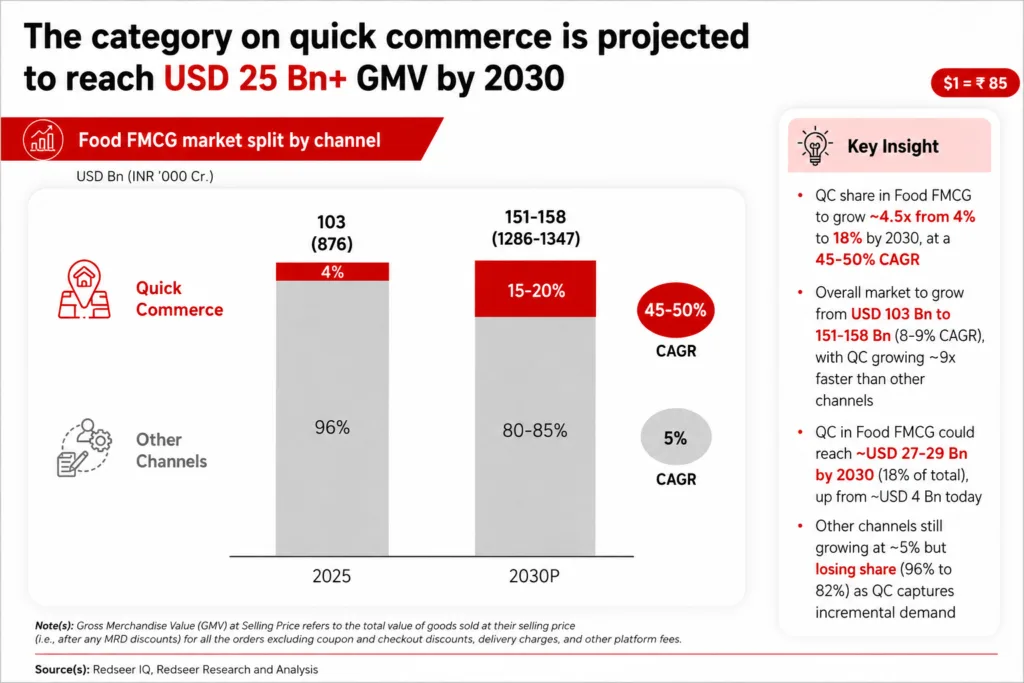
India’s Food FMCG market is around USD 103 Bn today and gets to about USD 155 Bn by 2030. That is 8 to 9% a year, which is the sort of number that lets a large brand carry on exactly as it has been.
The channel split is where it stops being comfortable.
- Quick commerce share quadruples, from 4% today to 15 to 20% by 2030
- It grows nine times faster than every other channel
- Traditional channels still grow, at a steady 5% a year
- But their share of the market falls from 96% to about 82%
None of this means the older channels are in trouble. General trade is not collapsing and distributors are not going anywhere.
What changes is where the new demand shows up. Almost all of it lands in one channel, and that channel rewards a different set of decisions than the ones most brands were built on.
The number that matters: the market grows 8 to 9% a year, but quick commerce grows at 45 to 50%. Almost every new rupee in Indian packaged food is going to one channel.
The demand inside that channel is not spread evenly either. Grocery makes up about 70% of quick commerce sales and packaged food is roughly half of that, led comfortably by dairy and breakfast, with beverages, snacks and chocolate some way behind.
These are everyday items that people finish and reorder without thinking. Anything discretionary or niche barely shows up, which is worth knowing before you build a launch plan around the channel.
It is also worth keeping the geography in mind. Around three quarters of quick commerce sales still come from the top eight metros, even with 250 plus cities live, so this is a metro habit spreading outward rather than a national one that has already arrived.
2. Why ready to cook is finally working in India
Ready to cook has been the category that is about to happen in India for years now. Going by this report, it finally is.
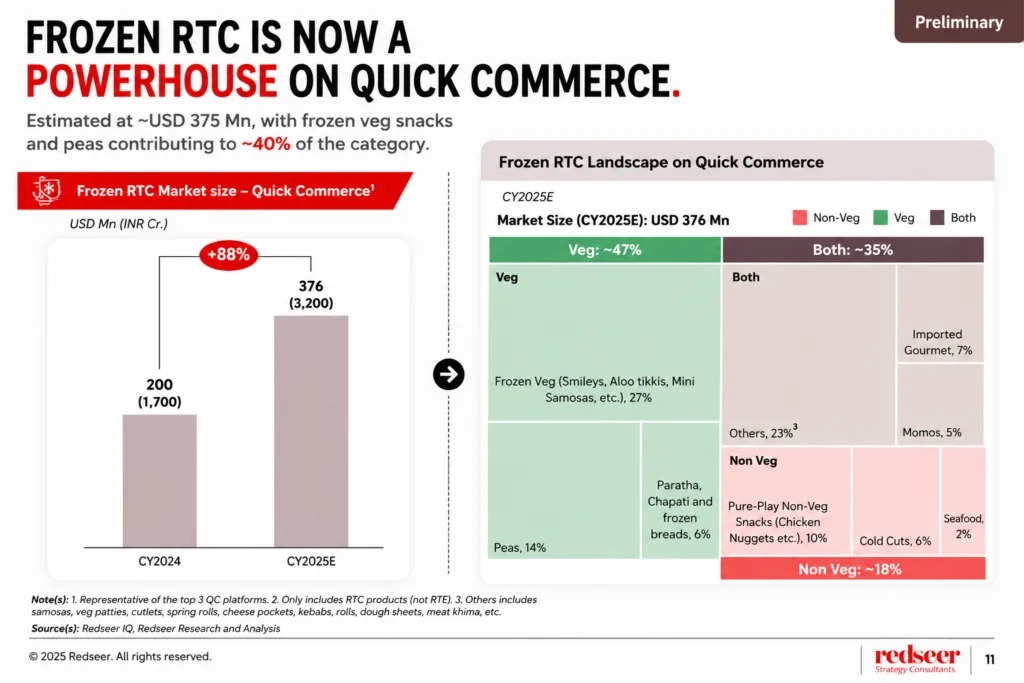
Frozen ready to cook on quick commerce nearly doubled in a single year, from USD 200 Mn to USD 376 Mn. Vegetarian products make up almost half of it, with frozen veg snacks and peas alone accounting for roughly 40%, so this is a mass-market story rather than a premium one.
None of the reasons behind that growth are about the food itself getting better.
- Delivery removed the planning. People can put off the meal decision until they are actually hungry. Ready to cook no longer has to win a place on the weekly grocery list, a fight it was always going to lose.
- Homes changed. Smaller, busier households cook less elaborately, and portion controlled formats suit them.
- Appliances caught up. Freezers, microwaves and air fryers are now common enough that frozen food is actually usable at home.
- Apps do the discovery. Browsing puts a new brand in front of someone at the moment they are deciding what to eat, which a shop shelf never did.
Chilled batter is worth a closer look here. It is a USD 400 Mn category where quick commerce already accounts for over 20% of sales, against low single digits for most other grocery categories.
The reason sits in the product. Batter spoils quickly so people buy small and often, the need is rarely planned, and nobody in a small flat wants a week of it sitting in the fridge.
Worth noting: quick commerce is already over 20% of the batter category, against low single digits for most other groceries. Short shelf life and unplanned need are what make the difference.
iD Fresh built that category the hard way, one refrigerated shelf at a time, and general trade still carries more than half of batter sales today. The fastest growing part of it now belongs to whoever wins the 8 AM search on an app.
3. India drinks far less than most other markets
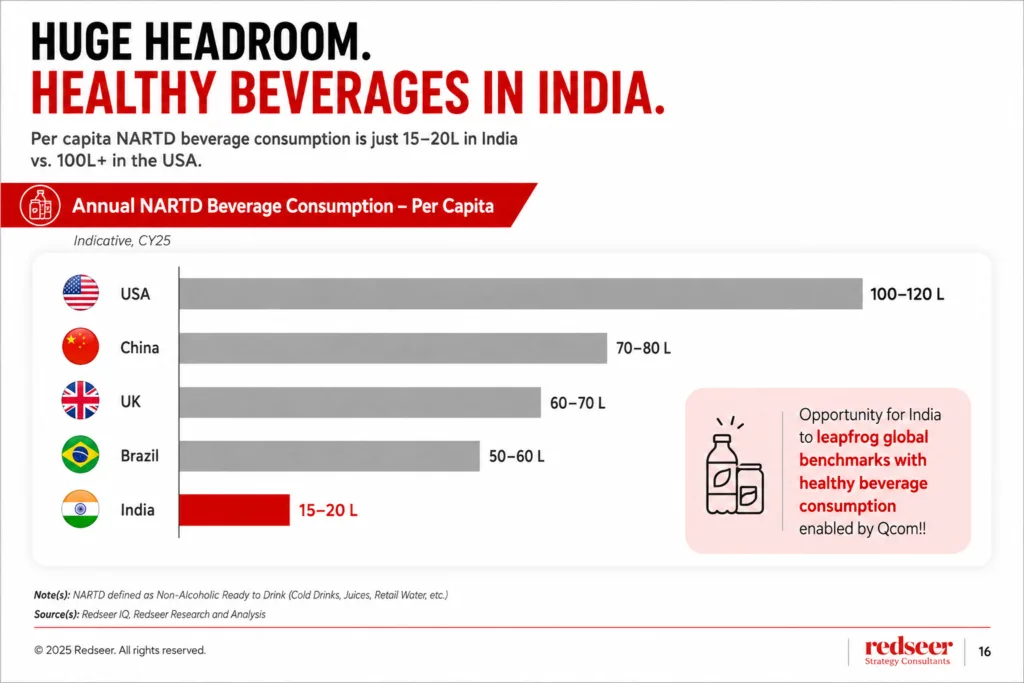
An average Indian drinks 15 to 20 litres of non-alcoholic ready to drink beverages a year. Brazil manages three times that, China four times, and the US closer to six.
You could read that as a small market. I read it as an open one.
Every one of those markets built its drinking habit on sugary carbonates, and all of them are now spending heavily trying to undo it. India is one of the few big markets that still gets to build the habit on better products from the start.
The category roughly doubles by 2030, to about USD 40 Bn. The quick commerce slice of it is growing at over 100% a year.
Coconut water shows how a fresh product turns into a packaged one. It is a USD 900 Mn market, but over 80% of it is still fresh coconut sold at the roadside, leaving a small packaged share that 60 to 80 brands are crowded into.
More than a fifth of those packaged sales now come through quick commerce. A drink people bought only when they happened to pass a vendor is slowly becoming something they keep at home, and the channel making that possible is the one that can put a chilled bottle at your door faster than you can walk to the corner.
This is not limited to one type of buyer either. Two out of three millennials say they will pay around 15% more for cleaner ready to cook and ready to eat products, and in Bharat roughly a third of mothers say the same about healthier sugar options.
You can already see brands responding, in Storia, Lahori Zeera, Fast&Up, Amul’s protein range and Pepsi’s prebiotic cola. The reason to buy has moved from taste alone to a function you can print on the label.
4. What happens to chocolate sales after 9 PM
India’s chocolate market grew about 10% between CY24 and CY25, from USD 2,300 Mn to USD 2,500 Mn. That is the headline, and it hides more than it tells.
Offline grew 5 to 8% in the same period while online grew 65 to 70%. Within online, quick commerce took 70% of sales, well ahead of marketplaces and scheduled grocery, and delivered roughly half of all the new growth in chocolate that year.
The time of day chart is the one I keep going back to. About 20% of online chocolate sales happen after 9 PM, and most of that before midnight.
The volume is only half the story though. Average selling price in that window is about 30% higher than during the day, which means people are reaching for costlier packs rather than whatever happens to be discounted.
Redseer reads that as spending driven by indulgence instead of price. Put plainly, your ₹250 pack has a far better chance at 10 PM than the same pack has at 10 AM.
Mornings work the other way. Those orders are planned and bundled, with a bar added quietly to a basket that already has breakfast and beverages in it.
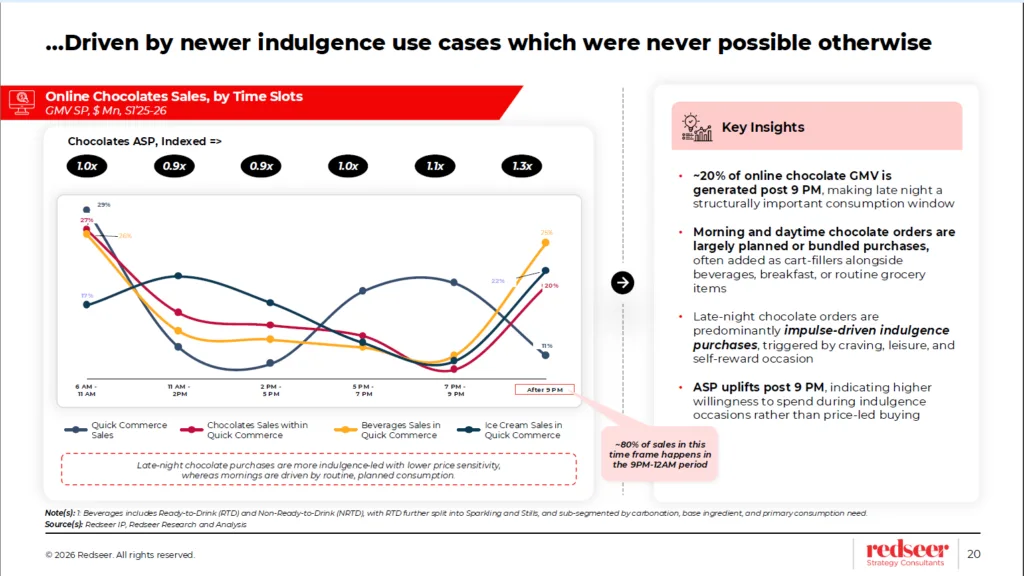
Same category, same customer, two different jobs about twelve hours apart. Most brands are still answering only one of them, usually the morning one, because that is the version that looks like traditional retail.
5. What Redseer suggests brands should do
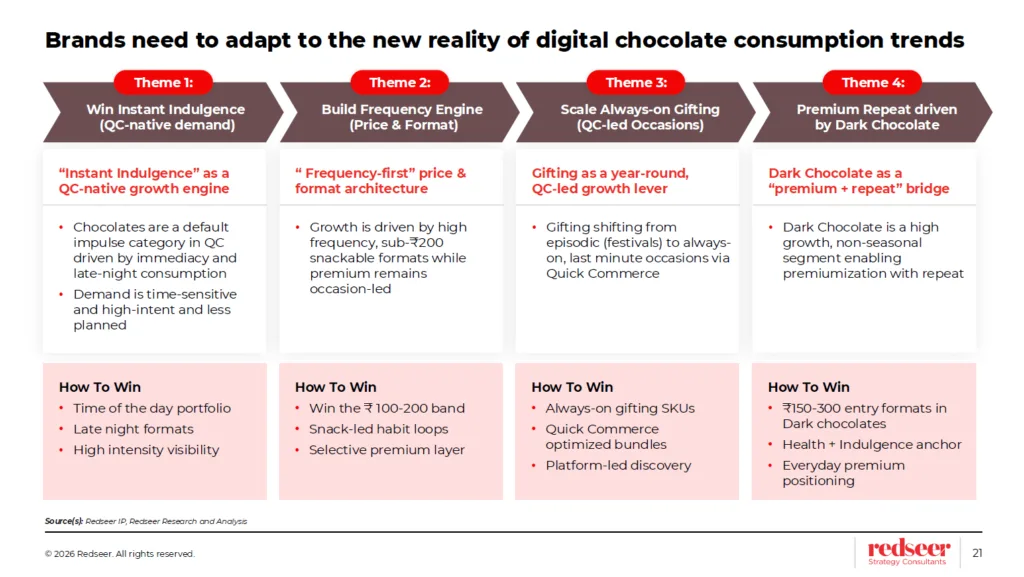
The report lays out four themes for how brands should respond, and they hold up well beyond chocolate.
The report lays out four themes for how brands should respond. They hold up well beyond chocolate.
- Win instant indulgence. Treat late night demand as its own business, not a spillover from retail. These buyers know what they want and order it immediately, so build a time of day portfolio and formats made for that window.
- Build a frequency engine. Growth comes from snackable packs under ₹200. Put the ₹100 to 200 band at the centre of your range and treat premium as a layer on top of it.
- Make gifting always on. Gifting is moving from festival spikes to last minute, any day occasions, because a gift now reaches someone in ten minutes. Keep gifting packs on the platform year round.
- Use dark chocolate as a bridge. It grows fast and sells all year rather than only around festivals. A ₹150 to 300 entry pack lets you sell health and indulgence in the same product.
The report never lists this as a theme, but for a smaller brand it might be the most useful thing in there.
Look for categories where nobody has really won yet. Where the top three brands hold only a small share between them, getting in is far easier. That is why new names keep turning up in frozen veg snacks and functional drinks. Try the same thing in dairy or chocolate and you are up against brands people have been buying for thirty years.
6. Conclusion
For thirty years the real constraint on Indian packaged food was shelf space. You built something that could survive a distributor, a retailer and six months in a warehouse, then spent money getting people to ask for it by name.
Quick commerce removed most of that and replaced it with a harder constraint. Your product now has to make sense to somebody who is hungry, bored or out of batter, at that exact moment, on a screen the size of their palm.
That is why the same brand needs a different answer at 8 AM and at 11 PM. One of those is a planned basket and the other is a craving, and going by this report, the craving pays better.
Data in this article is from Redseer Strategy Consultants, “Reinventing Packaged F&B with Quick Commerce”, March 2026.
If you would like to talk about how we can help build your quick commerce and omnichannel strategy, do reach out to us at saurabh@daiom.in.
For more such deep-dives and insights, follow and stay tuned to DAiOM. Subscribe to our NEWSLETTER!