
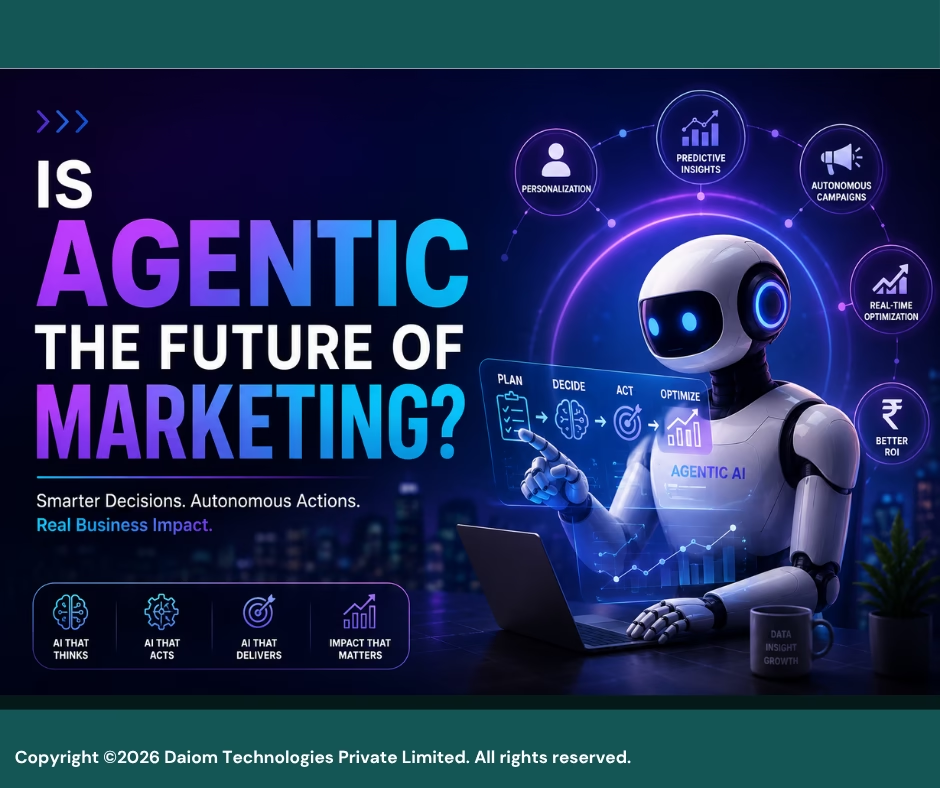



Is the future of marketing agentic?
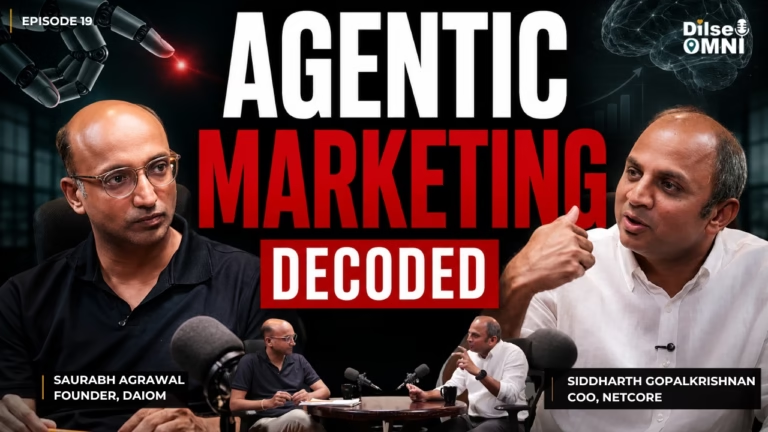
I’ve been asking myself this question ever since my conversation with Sidharth Gopalakrishnan, COO of Netcore, on DilSe Omni Talks. And the honest answer is more nuanced than the hype suggests, but far more compelling than the skeptics admit.
Here’s the thing. Generative AI is expected to unlock up to $4.4 trillion in annual economic value, and marketing is where its impact is already being felt first. Walk into any marketing team today and you’ll find AI everywhere: copywriting tools, image generators, video creators, personalization engines, customer insight platforms.
So AI adoption isn’t the problem.
The problem is how it’s being used.
1. The Real Challenge: Marketers Are Using AI in a Broken Manner
Today’s marketing teams are using different sets of AI tools for different jobs, one tool writes the copy, another generates the creative, a third builds segments, a fourth surfaces insights. Each one works. But none of them talk to each other.
The copy doesn’t know what the segment engine learned. The creative doesn’t know which past campaigns converted. The insights sit in a dashboard nobody acts on until the next planning cycle.
It’s AI, but in fragments. Disconnected. Broken.
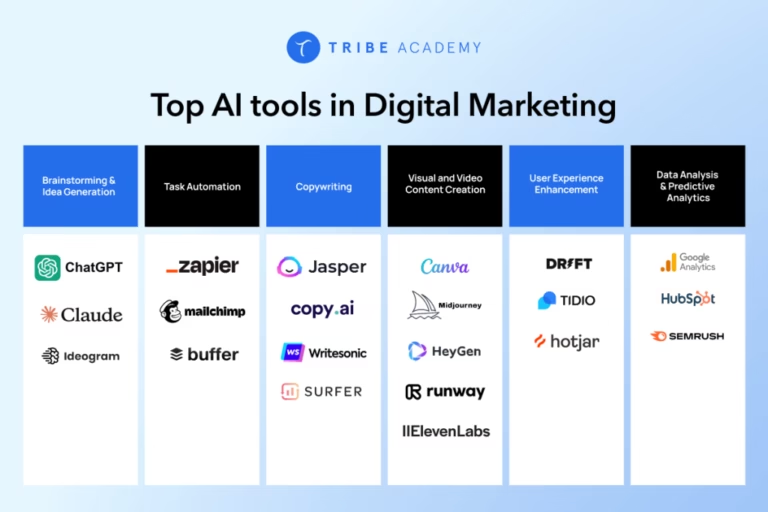
And this is exactly where agentic marketing enters, not as another tool to add to the stack, but as the connective layer where AI agents work together to plan, create, execute, optimize, and learn across the entire customer journey.
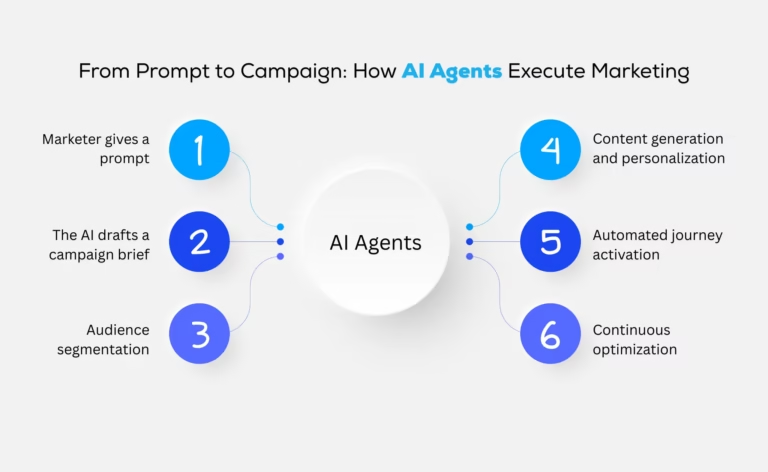
As Sidharth put it during our conversation:
Agentic marketing is the new way of solving impossible problems that marketers have faced for generations.
Because here’s what struck me most, the problems haven’t changed in 25 years.
- How do we reach the right customer?
- How do we personalize at scale?
- How do we retain?
- How do we grow without endlessly inflating acquisition budgets?
Netcore started when email was the only digital channel. Today there are dozens of touchpoints, yet marketers are still solving the same five problems.
Take a bank with 50 products and limited real estate on its app. Which product gets visibility, for which customer, at which moment?
Every product team has a priority. Every marketer wants to communicate. Too much communication is itself a problem. For years, we accepted this as unsolvable. Agentic systems are the first real shot at solving it.
2. How to Approach Agentic Marketing: The 5-Layer Framework
The most valuable thing Sidharth shared was Netcore’s five-layer framework. What makes it useful is that it moves the conversation away from tools and toward architecture.
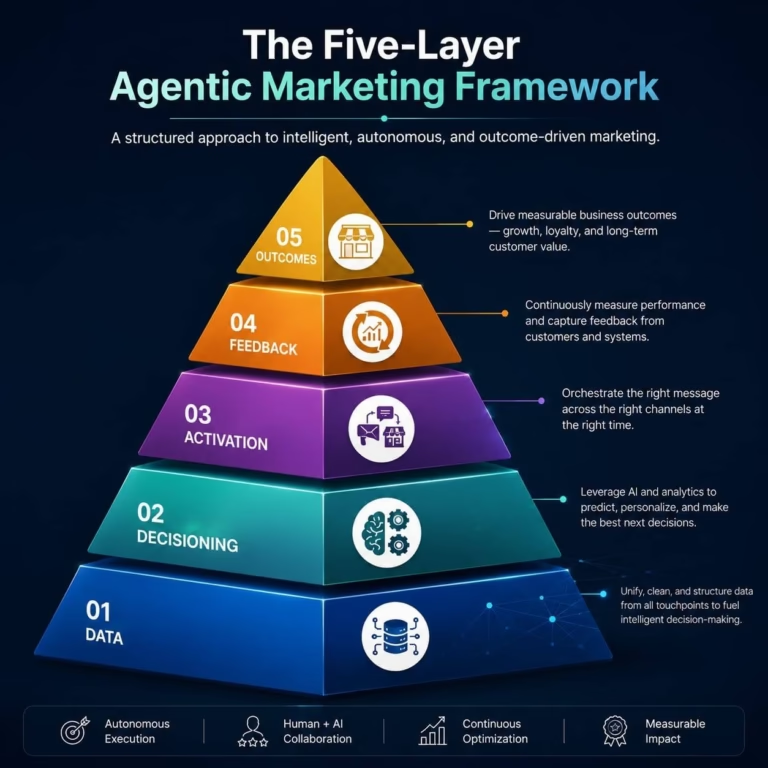
Layer 1: Data and Security. Everything begins with trusted first-party data: consent, privacy, governance, and secure access. With India’s DPDP Act, cookie deprecation, and rising privacy expectations, this is no longer a backend concern. Without this foundation, every layer above it produces garbage.
Layer 2: Decisioning. This is where agents earn their keep. They identify cohorts, create micro-segments, recommend journeys, generate campaign briefs, and prioritize next-best actions, with a central orchestrating agent aligning everything to a business objective.
Layer 3: Activation. Decisions mean nothing without execution. The system activates across web, app, email, SMS, WhatsApp, RCS, call centres, branches, stores, and dealerships, every touchpoint where your customer actually is.
Layer 4: Feedback Loop. Every interaction generates data that flows back into the system in real time. Decisions improve continuously. This closed loop: data, decision, action, learning, is what separates an agent from a rule-based automation.
Layer 5: Outcomes. The layer that matters most. Revenue, repeat purchase, conversion, profitability, customer acquisition cost. Not open rates. Not clicks. As Sidharth said: “Agentic marketing is outcome-driven, not activity-driven.”
The flow is simple to remember:
Data & Security → Decisioning → Activation → Feedback Loop → Better Outcomes
And at the center sits a principle I keep coming back to: human in the loop does not mean human in every loop. Experts define the problem, set guardrails, and approve significant decisions. But if every output needs manual control, you haven’t built an agent — you’ve built another rule-based tool with extra steps.
What This Looks Like in Practice
One of India’s largest gifting portals ran their Valentine’s Day campaign with a constrained budget but the same revenue target. Traditionally, a four-member team would spend around 10 days studying past performance, building strategy, choosing segments, and planning creatives.

With an AI engine ingesting their historical campaign and creative data, that came down to one or two days. The system found that only three or four creative approaches had ever worked exceptionally well. The team concentrated their limited budget on those, and hit their revenue goal.
The time saving was nice. The strategic focus was the real win. They stopped spreading the budget across ten experiments just because that was the old process.
Why did it work? Leadership believed in the experiment, the internal team gave the agent business context and challenged early recommendations, and crucially, they gave the agent enough freedom to run, correcting course rather than controlling every move.
3. Should You Build or Buy?
Sidharth’s answer was refreshingly practical. If you have a 20–50 member analytics-savvy technology team, strong data architecture, and appetite for continuous innovation.. build your own agents. Your internal teams have richer access to product, inventory, and business context than any vendor ever will.
If you don’t have that muscle yet, start with a partner, demonstrate early impact, build internal confidence, and earn the mandate to build in-house over time.
But the strongest model isn’t build versus buy at all. It’s build, buy, and collaborate your proprietary next-best-product engine working alongside a platform that activates those recommendations at the right moment, on the right channel.
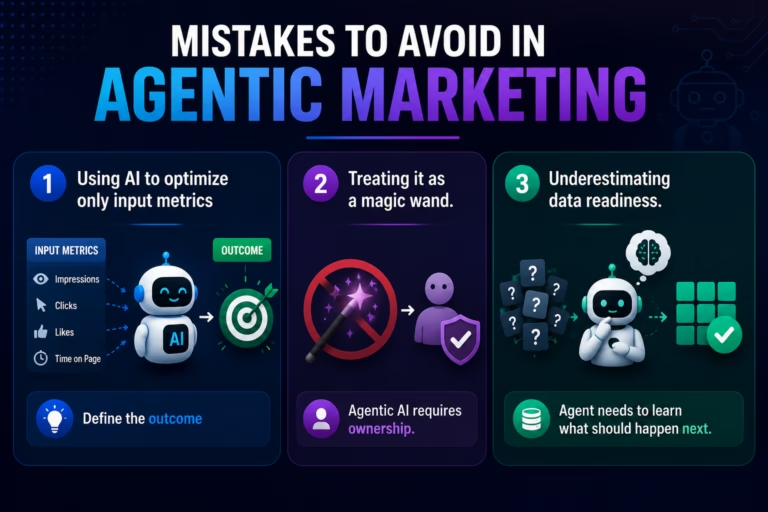
4. Three Mistakes to Avoid in Agentic Marketing
Sidharth’s advice for CMOs was direct, and each mistake maps to a failure I’ve seen repeatedly in the D2C ecosystem.
Mistake 1: Using AI to optimize only input metrics. Click-through rates, open rates, and campaign volume are diagnostics, not destinations. Define the outcome, revenue at a target cost, repeat purchase, a specific product goal. Agents perform dramatically better when the destination is clear. Point them at open rates and they’ll happily win a game that doesn’t matter.
Mistake 2: Treating it as a magic wand. Agentic AI requires ownership. Someone inside your organisation must own the goal, provide context, review progress, and build learning cycles. A platform without committed people becomes another underused platform, and your CFO already knows how that story ends.
Mistake 3: Underestimating data readiness. Data structures, integrations, consent, tokenization, secure access, this unglamorous work is central to success. The agent needs to learn who converted, why they converted, and what should happen next. Data doesn’t need to be copied everywhere, but it must be accessible in a governed, secure way. Skip this and you’ve built a Ferrari with no fuel line.
5. Why This Matters Now: The Cost of Waiting
If you’re wondering whether you can afford to wait this one out, consider what fragmented marketing is already costing you.
For years, marketing teams have been obsessed with customer acquisition. Performance marketing budgets have grown exponentially, with brands pouring millions into Meta, Google, marketplaces, and influencer campaigns to acquire new customers.
But Siddharth highlighted an uncomfortable reality.
Many brands are spending significant amounts of money to reacquire customers they already have.
Think about it.
A customer purchases once, becomes inactive for six months, and slowly slips into the “dormant” segment. Instead of nurturing that relationship through owned channels like email, WhatsApp, SMS, or app notifications, the customer often re-enters the funnel through paid advertisements.
The brand ends up paying to acquire the same customer twice.
Netcore calls this Ad Waste.
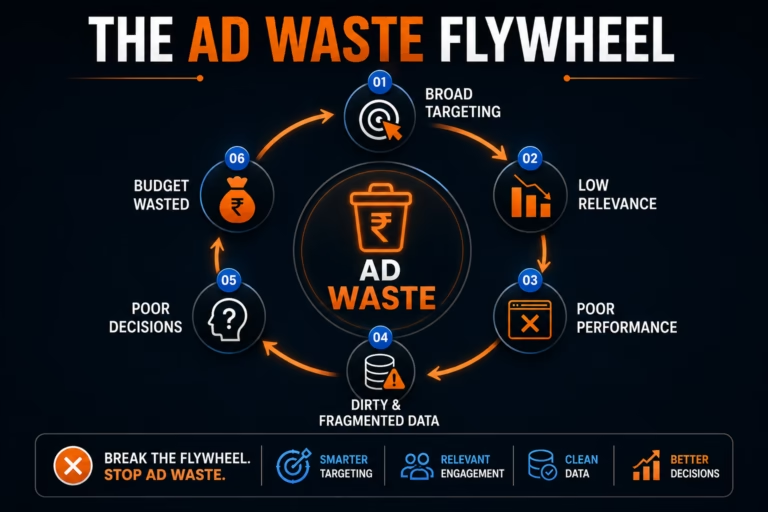
In one experiment, a fast-growing fashion brand ran a three-month dormant-customer revival through owned channels instead. They reactivated 30–40% of dormant customers at a fraction of paid reacquisition cost, and those customers came back with an average order value roughly 1.5 times the brand average.
That’s not a media efficiency problem. That’s a coordination problem. And coordination is precisely what agentic systems solve: connecting the insight (this customer is drifting) to the decision (reactivate via owned channels) to the action (a personalized WhatsApp journey) to the learning (what worked, for whom).
6. So, Is the Future of Marketing Agentic?
Sidharth’s honest assessment: agentic marketing today sits between the hype of inflated expectations and the beginning of real arrival. Experiments are at their peak. Netcore has over 100 customers live on its insight agents, but around 20 are true power users. Value is clearly possible. It just takes work.
Which means the answer to my opening question is yes, but not automatically, and not for everyone.
The future of marketing is agentic for brands that start now with discipline: pick a meaningful business problem, build the data foundation, put someone in charge of the outcome, run experiments continuously, and learn faster than the market.
The fundamentals of marketing aren’t changing: customer understanding, relevance, trust, outcomes. What’s changing is the speed at which we can analyse, create, test, and act. As Sidharth put it: “Understand what is not changing, and quickly adopt what is changing.”
The brands that win won’t be the ones with the most AI tools.
They’ll be the ones that stopped using AI in fragments, and started using it as a system.
I’m Saurabh Agrawal, and every fortnight on DilSe Omni Talks I sit down with leaders shaping omnichannel growth. Watch the full episode with Sidharth Gopalakrishnan on YouTube, and subscribe to the newsletter for practical insights on omnichannel growth, marketing leadership, and AI-led customer engagement.