



Last week, something was right and wrong at the same time. A Google search for the top contenders to become the next Chairman of Tata Sons brought up Saurabh Agrawal. The name was correct. The photograph beside it belonged to our founder, Saurabh Agrawal.
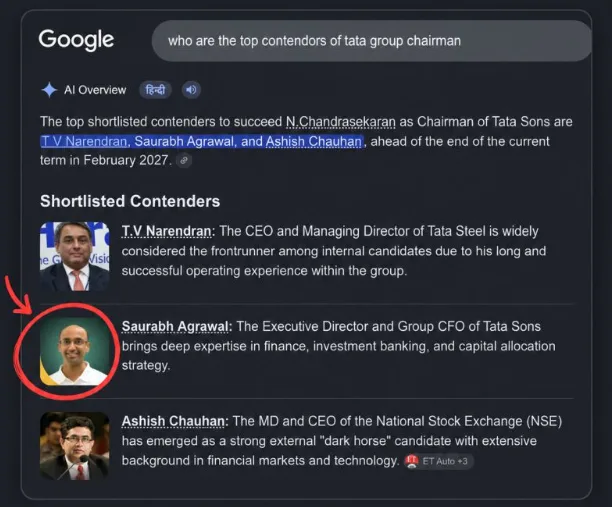
Same name. Same spelling. Wrong person
The mix-up was funny, especially because it had happened before. Nearly ten years ago, when the other Saurabh joined the Tata Group, people had confused the two then as well. This time, AI had simply brought the confusion back in a new form.
Saurabh shared the screenshot on LinkedIn, partly to clear things up and partly because the situation was too good not to share. What began as a funny case of mistaken identity soon became an example of how confidently AI can connect the right information to the wrong person.
AI search is becoming one of the first places people go to understand a person or a company, and then that kind of mistake matters. It made us look more closely at what shapes the answers we see, how AI decides which sources to trust, and why LinkedIn is becoming such an important part of that process.
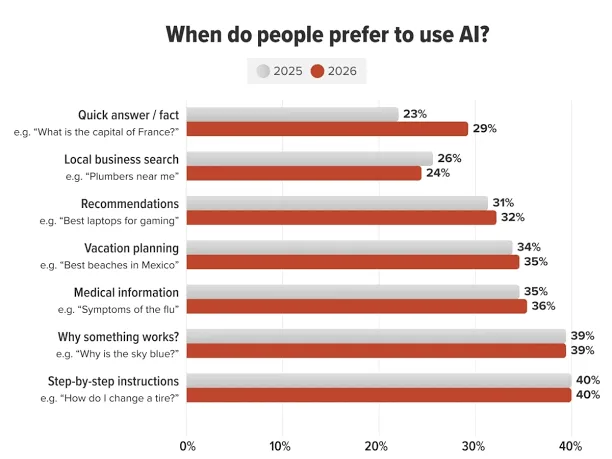
At first, we did not think much of the change. Most conversations about the future of search were focused on Reddit and how brands could get mentioned or cited there. So we assumed the small increase from ChatGPT was simply an interesting one-time spike.
But then we saw, in our website we started getting 5-6% traffic on AI. This started not because we are on reddit but because we are active on social media especially linkedin.
That made us look deeper and during our research we found Linkedin’s newly published Unlocking AI Search Visibility: the B2B Marketer’s Guide to LinkedIn. It explained almost exactly what we had been seeing in our own analytics also.This was not just limited to our website but was part of a much bigger change in how people discover information online.
So, we went through LinkedIn’s playbook, studied the research behind it, and compared it with our own traffic data. From this, we identified five clear signals that suggest this shift is real.
1. Here’s Why LinkedIn Is Showing Up in AI Answers – How to rank higher on AI searches
For a long time, nearly every discussion about AI visibility arrived at the same answer: get mentioned on Reddit. The advice made sense because Reddit is full of detailed, first-hand conversations. We assumed our answer would be somewhere along those lines too. It was not.
AI search has quietly changed the rules of online visibility.
The mechanism behind it is zero-click search. When an AI tool answers a question directly inside the conversation, the user gets what they need without visiting any website at all. Google’s AI Overview gives you the answer before you reach the first result. ChatGPT, Gemini, Perplexity, and Copilot go a step further: they let you research, compare, and sometimes make a decision without leaving the chat.
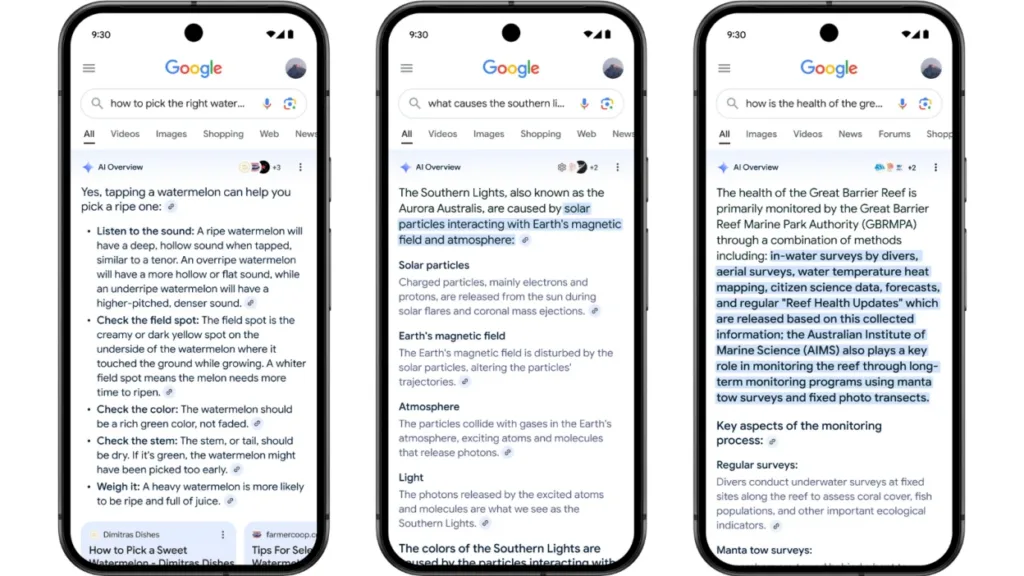
The effect is already visible in real traffic data. Pew Research Center found that people clicked a traditional Google result in only 8% of visits when an AI summary appeared, compared with 15% when it did not. Just 1% clicked a source link inside the summary itself.
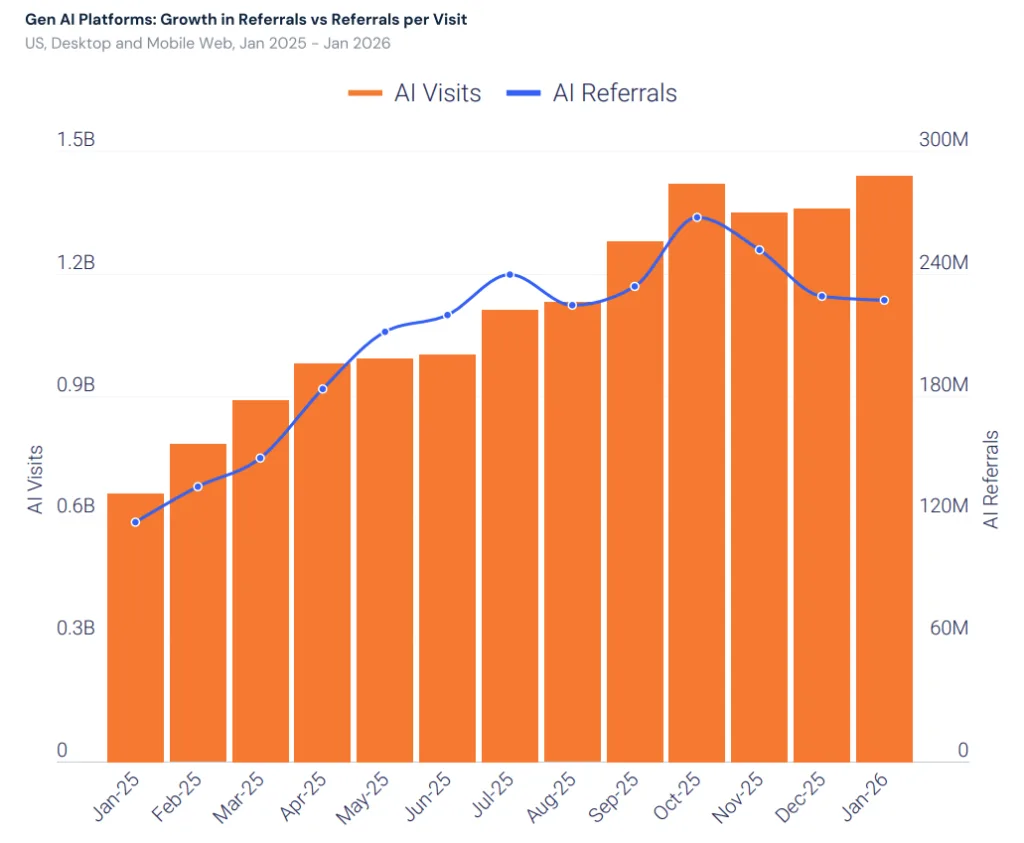
Similarweb found something similar: visits to AI platforms were moving toward 1.5 billion a month, while the referral traffic they sent to outside websites remained almost flat at roughly 240–280 million visits. People are using AI more. They are simply not clicking out at the same rate.
Companies are losing traffic they used to count on, not because their content got worse, but because the destination moved. Your website may now help produce an answer without receiving the visit. That does not make the brand invisible. It means visibility and traffic are no longer the same thing. A buyer can discover your company, compare it with a competitor, and form an opinion entirely inside an AI answer. The first question is no longer only whether they click, but whether your brand appears in the answer at all.
The interesting part is how often LinkedIn appears when people ask about companies, products, careers, industries and professional expertise.
LinkedIn content is therefore becoming part of search visibility. If the company, its founders and its experts are not explaining the category clearly, an AI tool may end up learning it from somebody else.
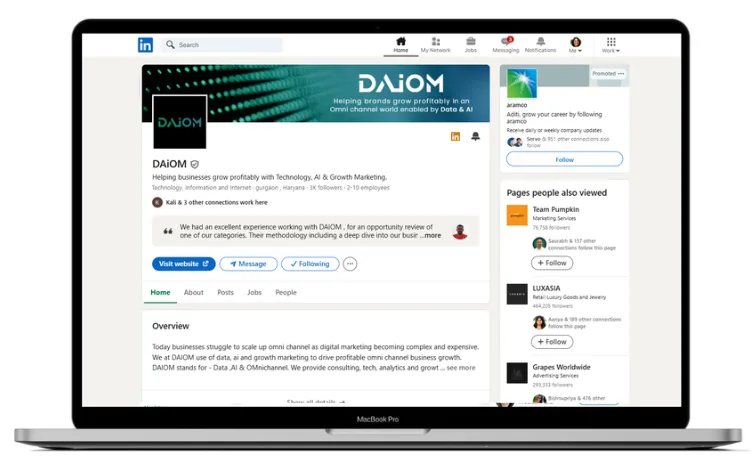
That is what makes this different from ordinary social reach. A feed post is usually judged by what happens during its first few hours or days. A useful public post can now have a much longer life: it can be found later, connected to a specific question and used as supporting material in an AI-generated answer. The value is not limited to how many people happened to be online when it was published.
2. How to optimize for AI Search?
Today globally 1.3 billion members are on linkedin.
Most LinkedIn strategies are built around feed posts because posts are quick to create and easy to distribute. But for AI visibility, long-form articles appear to have an important advantage.
The simpler rule is: publish information that answers a real question clearly.
Text remains particularly important. In the Meltwater study, text posts accounted for 72% of cited LinkedIn content. Articles contributed another 12%, taking text-based content to 83% of LinkedIn citations.
Articles performed especially well, earning 6.5 times more AI citations than standard posts. The strongest were focused explanations, comparisons and decision guides rather than vague opinion pieces.
The top-cited articles also had a few things in common:
- Every one used bullet points or numbered lists.
- 92% used clear section headings.
- 75% named specific companies or tools.
- 67% included hard numbers or data.
- Half used some form of comparison or evaluation framework.
Semrush found that LinkedIn Articles accounted for 50–66% of cited LinkedIn content, depending on the AI platform, while feed posts contributed 15–28%. LinkedIn’s internal data similarly says that Articles make up about 60% of LinkedIn citations in AI search, compared with 40% for posts.
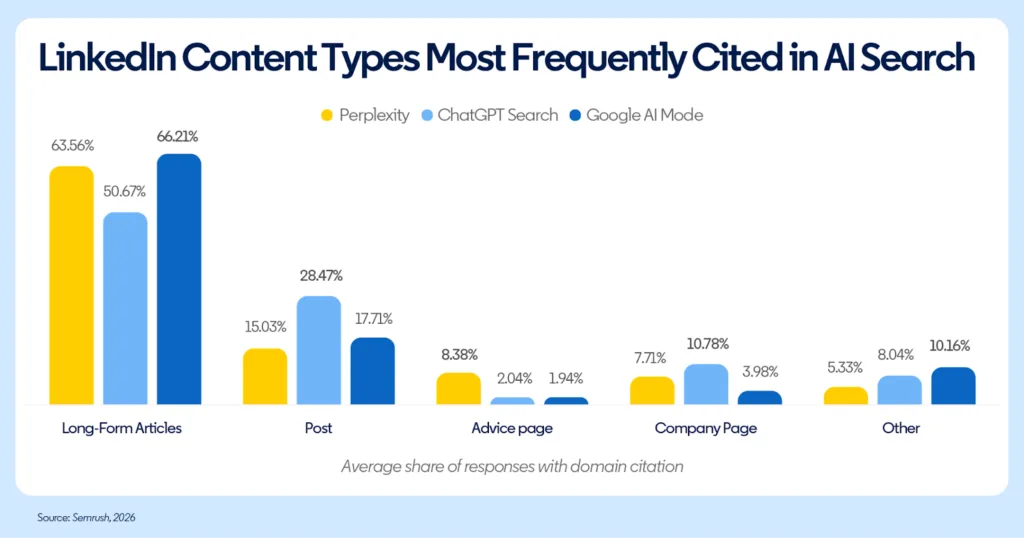
This makes sense when you think about how an Article is written. There is room for a proper answer, useful examples, data and a clear conclusion. It gives readers more context and gives an AI system something structured enough to understand and quote.
That does not mean every brand must publish a long essay each week. The most frequently cited Articles in the Semrush study were between 500 and 2,000 words. Length alone is not the point. A good Article picks one useful subject and explains it properly.
This also gives Articles a different job from feed posts. A post can introduce one observation or start a conversation. An Article can hold the complete explanation that sits behind it. The two formats work better together than as substitutes: the post creates an entry point, while the Article gives the idea enough depth to remain useful outside the feed.
3. LinkedIn Has Quietly Become an AI’s Favorite Source
A Meltwater study of 9.5 million AI citations looked at six major AI systems across 16 B2B categories. In that study, YouTube was the most-cited social source, followed by LinkedIn and then Reddit.
LinkedIn’s citation share was 0.53%, compared with Reddit’s 0.44%. That put LinkedIn 1.2 times ahead of Reddit for the B2B prompts studied.
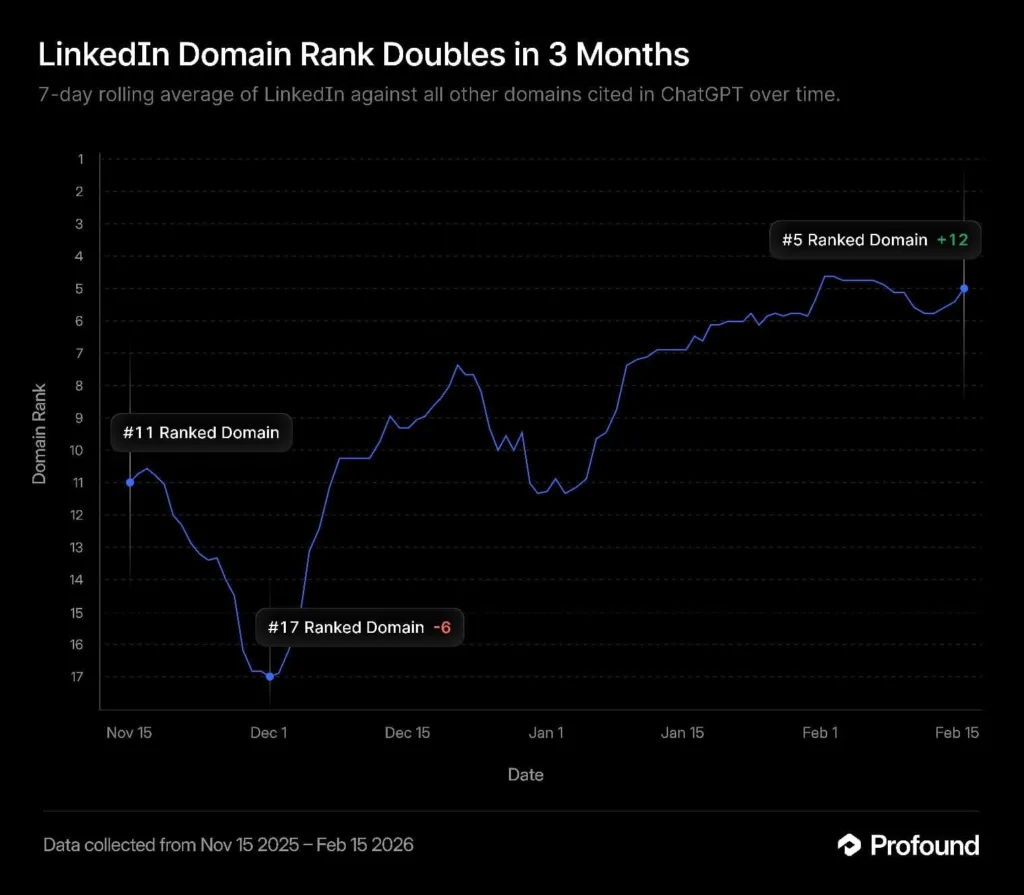
The useful part is the relative position: LinkedIn has moved ahead of the platform most people associated with AI visibility. It also ranked among the top five cited sources in 14 of the 16 B2B categories studied, including marketing, leadership, sales, financial services, technology, retail and healthcare.
LinkedIn will not win every search. A skincare recommendation may lean towards Reddit, TikTok or YouTube. But for B2B brands, the signal is hard to ignore.
LinkedIn already contains the people AI needs to understand a business: its founders, employees, customers, partners, competitors and industry experts. It also connects every opinion to a name, role, company and professional history.
That context is valuable. An anonymous comment can describe an experience. A LinkedIn post can describe the same experience while also showing who said it and why their view may carry weight.
LinkedIn officially reports more than 1.3 billion registered members worldwide. They are not all monthly active users, but the people who may buy from you, hire you or shape your industry are already there.
One of the clearest findings in the study is that AI systems reward original explanation.
4. Visibility Is Being Built by People, Not Only Company Pages
If brands want to appear in AI answers, the obvious reaction is to publish more from the official Company Page.The data suggests that is only part of the answer.
In Meltwater’s study, 75% of LinkedIn citations came from individual profiles. Company Pages accounted for the remaining 25%.
Even more interestingly, 51% of citations came from people with fewer than 10,000 followers.AI visibility is therefore not reserved for celebrity founders or huge corporate accounts. A smaller profile with specific expertise can still become a source.
A Company Page can explain what the business sells, publish official research and keep its positioning consistent. But employees and founders can share the details that usually get removed from corporate communication: what went wrong, what customers keep asking, which assumption changed, how a decision was made and what the team learned by actually doing the work.
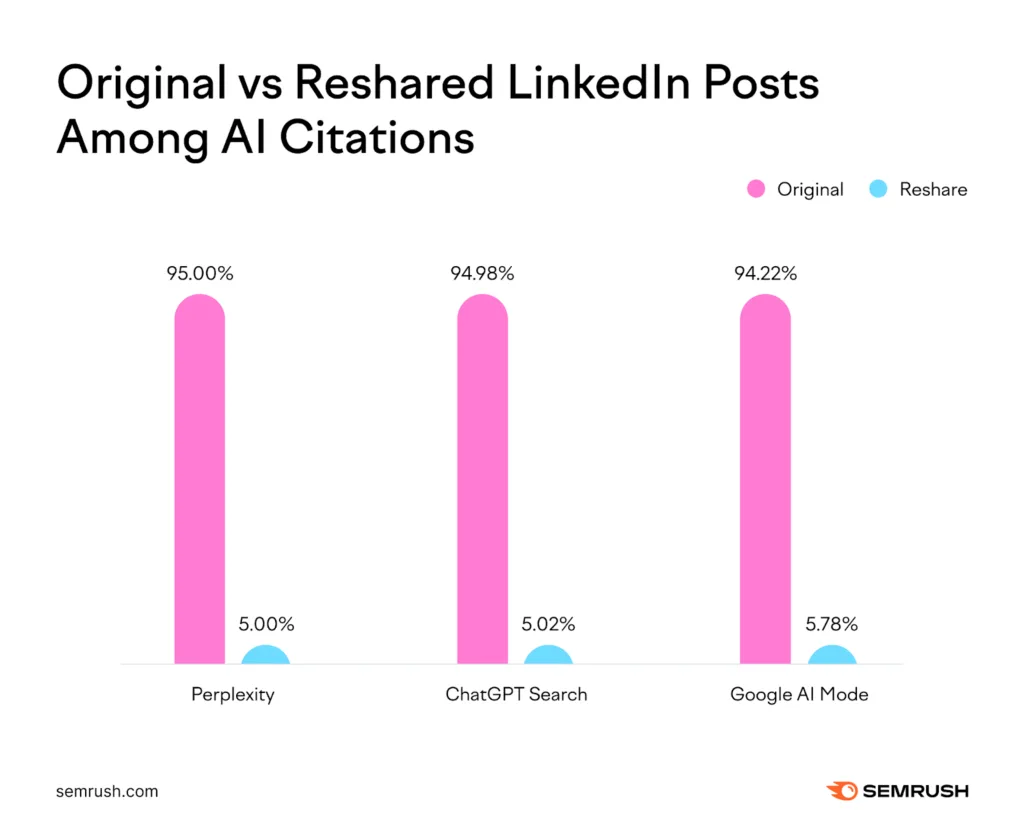
Those voices help create the public body of knowledge from which AI understands the company.Approximately 95% of cited LinkedIn posts were original, while reshares represented only around 5%. Between 54% and 64% of cited posts focused on sharing knowledge or practical advice.
For brands, “original” does not have to mean publishing a large research report every month. It can mean:
- Explaining a process your team understands well
- Sharing a pattern seen across customer conversations
- Turning internal data into a useful benchmark
- Documenting the result of an experiment
- Giving a specific point of view on a change in your industry
In simple terms, useful and specific beats broad and polished.
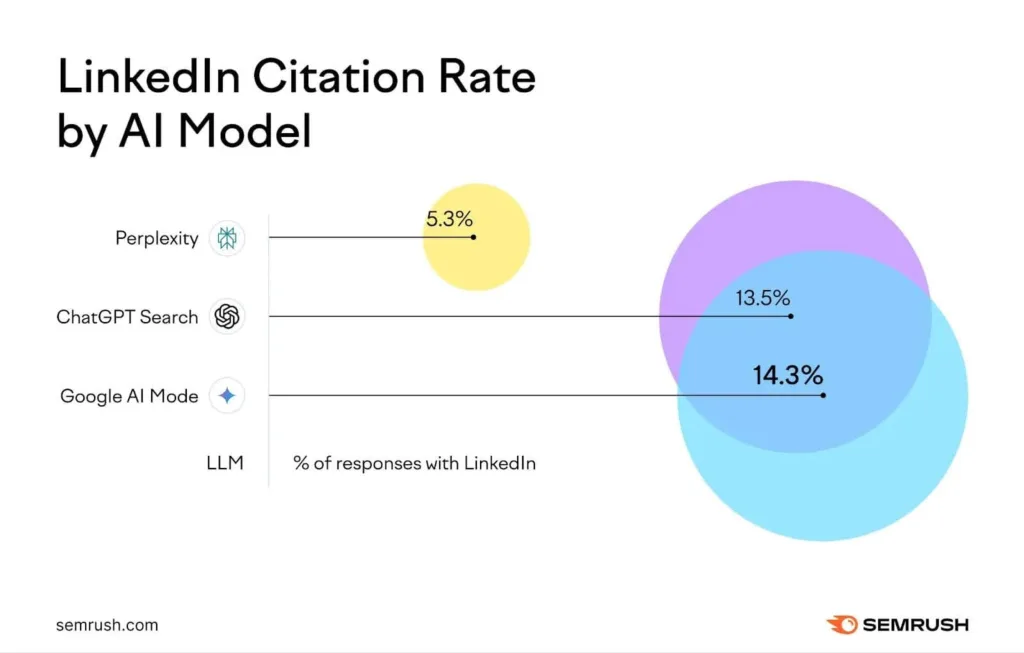
Per data cited from Semrush, LinkedIn ranks second among all platforms for AI citations, meaning that when ChatGPT, Perplexity, or an AI Overview needs to back up a claim about a company, an industry trend, or a B2B product, LinkedIn content is disproportionately likely to be the source it reaches for.
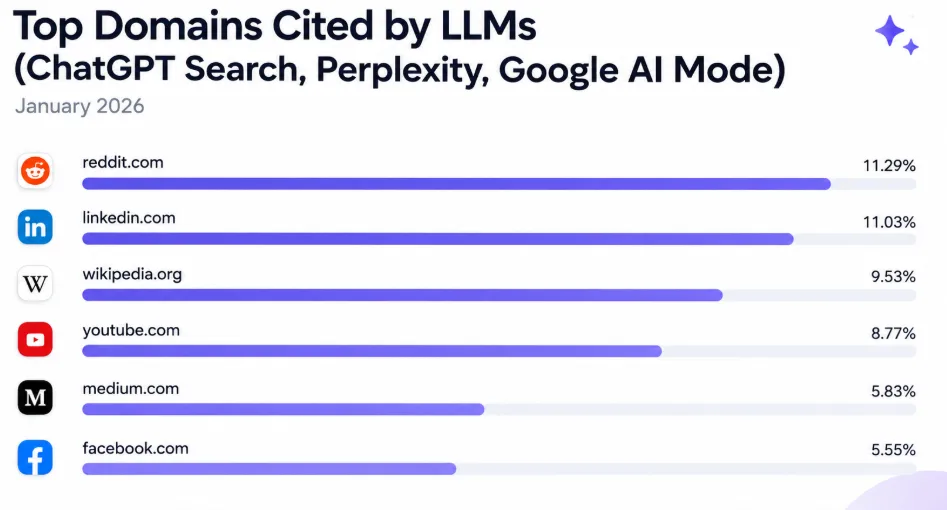
That’s exactly the pattern we noticed. We hadn’t done anything dramatically different on LinkedIn, no new campaign, no paid push. We’d simply kept publishing our usual analysis and opinion pieces there. But somewhere in the last few months, that steady publishing seems to have started compounding into AI visibility we weren’t specifically chasing.
5. Being Cited Isn’t the Same as Being Clicked
Here’s the twist that surprised us most while reading through the research: showing up inside an AI answer doesn’t automatically mean people click through to your site. In fact, for most brands right now, it doesn’t.
Similarweb’s own tracking backs this up. AI-driven visits to external sites climbed steadily toward 1.5 billion a month, while AI referral traffic stayed essentially flat, hovering between 240 and 280 million a month from mid-2025 through January 2026. Similar web calls this a permanent structural decoupling: usage is exploding, but referrals simply aren’t keeping pace. The conclusion the report draws, and one we’d agree with, is that AI visibility today is primarily a brand-authority play, not a traffic play.
Being the brand an AI recommends shapes how a buyer perceives you before they ever land on your website. It builds trust during the research phase and determines whether you’re even part of the shortlist when a purchase decision starts forming, often before a single click happens.That’s a very different job that SEO traffic used to do.
6. The Rules of Content Itself Are Being Rewritten
Put the first four signals together and a clear pattern emerges: the entire discipline underneath search marketing has shifted. Here’s a simple before-and-after, based on what LinkedIn’s playbook and the broader 2026 AEO research point to:
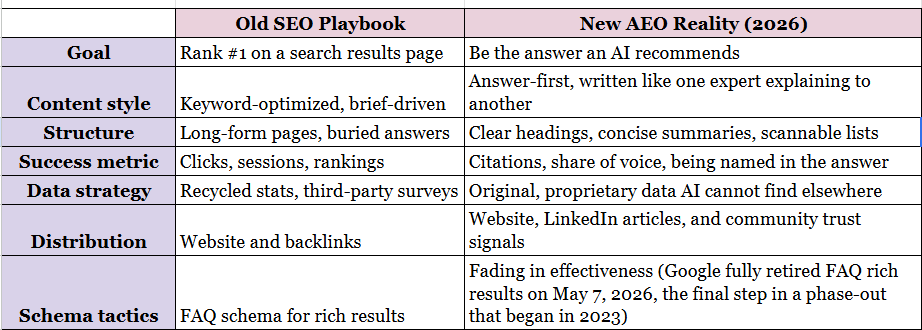
Two things stand out here:
- First, original data has become the currency of AEO. AI platforms are increasingly good at recognizing when a stat is simply recycled from somewhere else, so content built entirely on third-party numbers is unlikely to get cited.
Brands that can generate their own data, from customer surveys, sales conversations, or internal benchmarks, have a real structural advantage.
- Second, readability itself is becoming a ranking signal. The advice repeated across nearly every 2026 AEO analysis we came across boils down to one test: read your content out loud. If it sounds like a content brief executed by a robot, it needs a rewrite. If it sounds like one smart person explaining something to a colleague, leave it alone.
Machines, somewhat ironically, are rewarding writing that sounds more human, not less.
- The LinkedIn part is important because it sits between an owned website and a social feed. It gives a company an official presence, but it also contains identifiable people sharing experience in their own words. That combination gives AI tools both structured brand information and the human context that is often missing from a conventional landing page.
A LinkedIn post or Article has to carry useful information on its own. If the only meaningful sentence sits behind a link, there is very little on the platform for a reader or an AI system to understand.
7. What This Means for Brands & Marketers
We’re not sharing this because we’ve cracked AEO. We’re still in the early innings of understanding exactly how much of our own traffic shift is AI-driven versus coincidence. But the pattern was real enough, and consistent enough with what LinkedIn and the wider research community are now documenting, that it felt worth writing about.
If you run marketing for a brand in India right now, here’s what we’d genuinely suggest checking this week:
- Look at your own referral data. Go into GA4 (or whichever analytics tool you use) and check your referral sources for chatgpt.com, perplexity.ai, and any AI-labeled traffic. You may be surprised by what’s already showing up quietly.
- Audit your LinkedIn publishing cadence. If LinkedIn is genuinely a preferred AI citation source, consistent, opinionated, expert-written LinkedIn articles are no longer just a personal-branding nice-to-have. They’re becoming a discovery channel in their own right.
- Rewrite your best pages to be answer-first. Structure your most important content, pricing pages, comparison pages, “how it works” pages, so the answer sits in the first two sentences.
- Invest in original data. A proprietary survey, a benchmark report, or an internal dataset turned into a public insight is far more likely to earn an AI citation than another summary of someone else’s numbers.
- Stop measuring AEO by clicks alone. Track brand mentions and citations across AI platforms as a separate metric from website traffic. They measure two different things, and both matter.
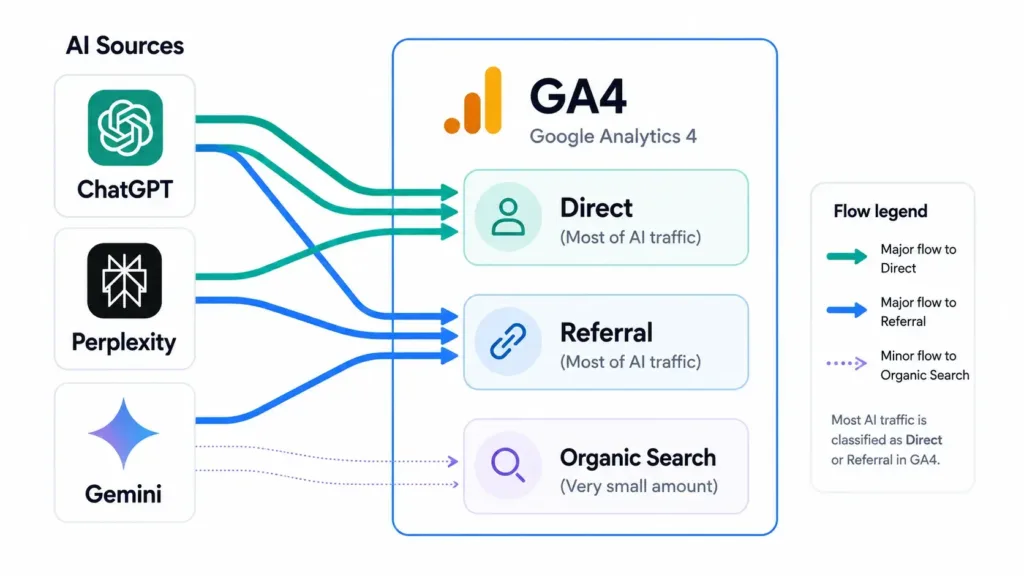
If we zoom out, this isn’t really a story about ChatGPT or LinkedIn specifically. AI has quietly moved from “a tool we experiment with” to “the place our customers actually go first.” First it was ChatGPT crossing a billion users. Then it was AI showing up inside product research and shopping. Now it’s showing up in our own web analytics, on a random Monday morning, as an unassuming little line in a referral report.
We didn’t go looking for this shift. It showed up in our own data before we went looking for the research to explain it, and that, more than any single statistic in this piece, is probably the most convincing evidence of all. The brands that notice this early, the way we happened to, are the ones who will have a real head start when everyone else finally checks their own analytics and asks the same question we did: wait, why is ChatGPT sending us traffic?