



A couple of weeks ago I put up a poll on LinkedIn, “What’s the biggest reason you don’t get quality sleep?”
53% said social media. 25% said OTT and binge-watching. Together, that’s nearly 80% of people pointing at a screen.
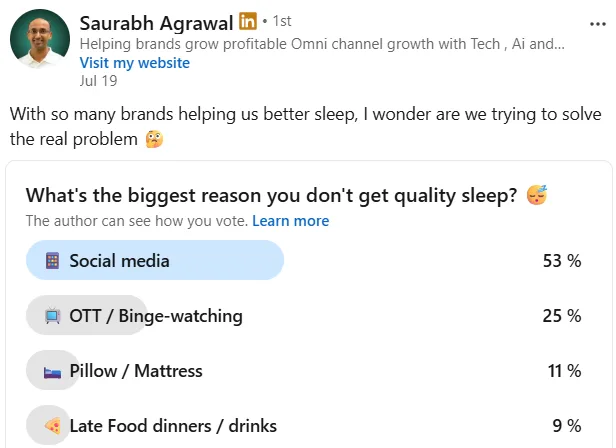
And I couldn’t help but wonder, with so many brands out there selling us better sleep, are we even going after the right problem?
That poll reminded me of something I’d read a while back. Reed Hastings, back when he was running Netflix, was once asked who he thought their biggest competition was. He didn’t say Amazon. Didn’t say HBO.
He said sleep.
“You get a show or a movie you’re really dying to watch, and you end up staying up late at night. So we actually compete with sleep. And we’re winning.”
That was 2017. People laughed. But it wasn’t really a joke.
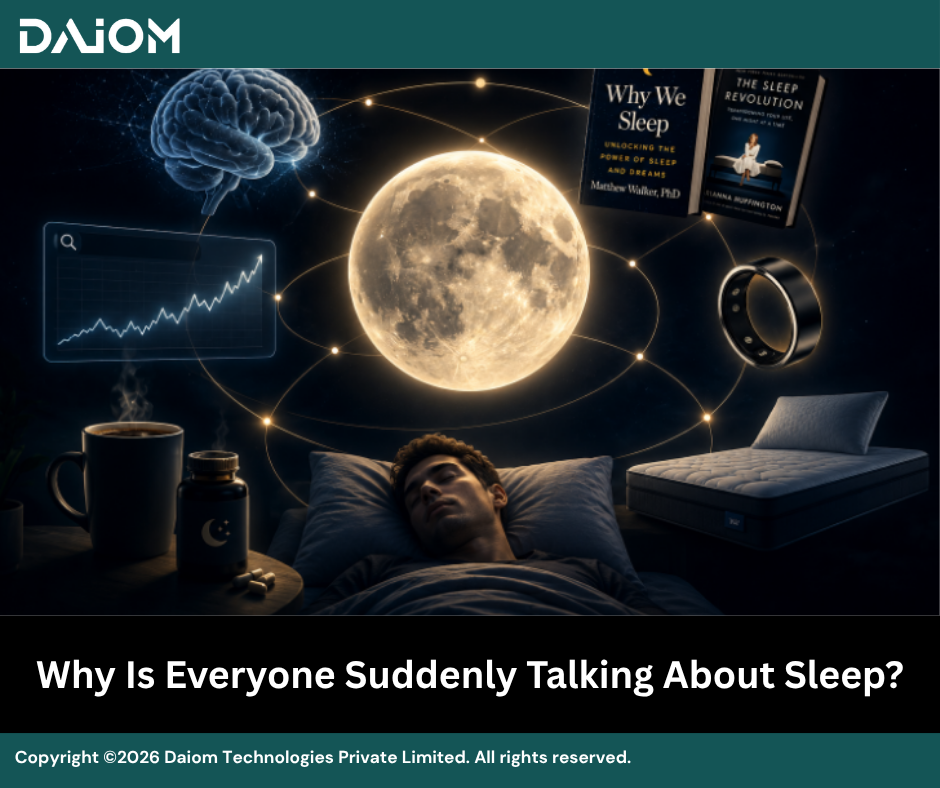
But here’s what’s interesting. In the years since, sleep has gone from being the thing we were losing to, to being the thing people are spending serious money to win back. Entire brands have been built around it — mattresses, supplements, wearables, apps. And on the other side, coffee and energy drink brands have made keeping you awake their whole identity. Either way, sleep is now the business.
I got curious about how we got here. So I did some reading. Here’s what I found.
1. What Google Search Is Actually Showing Us
1. What Google Search Is Actually Showing Us
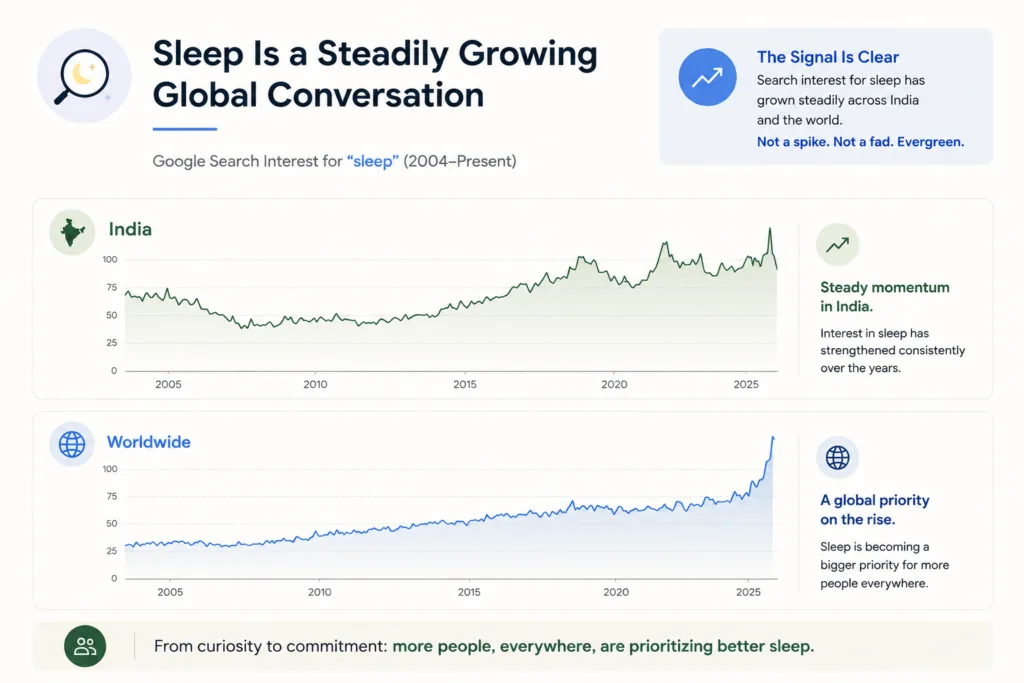
One of the easiest ways to know what people genuinely care about is to look at what they’re searching for. And when you look at sleep – it’s been climbing steadily on Google for years now. Not a spike, not a trend that came and went. Just steady, consistent growth. The kind that tells you something has actually changed in how people think.
The more interesting thing is what people are actually searching for. Five years ago it was stuff like “why am I always tired” or “how to fall asleep fast.” Basic stuff. Today it’s completely different – “deep sleep vs REM sleep,” “best magnesium for sleep,” “mouth tape benefits,” “sleep tracking ring India.”
That’s a very different kind of search. Someone who knows what they’re looking for – and why.
Something clearly changed the way people think about sleep. And I think it comes down to two things – the science, and the books that made that science accessible to everyone.
2. The Science That Made It Impossible to Ignore
For decades, sleep research lived in journals nobody outside academia read. Then two ideas went mainstream – and changed how people think about sleep entirely.
2.1 Your Brain Has a Self-Cleaning Mode – and It Only Runs at Night
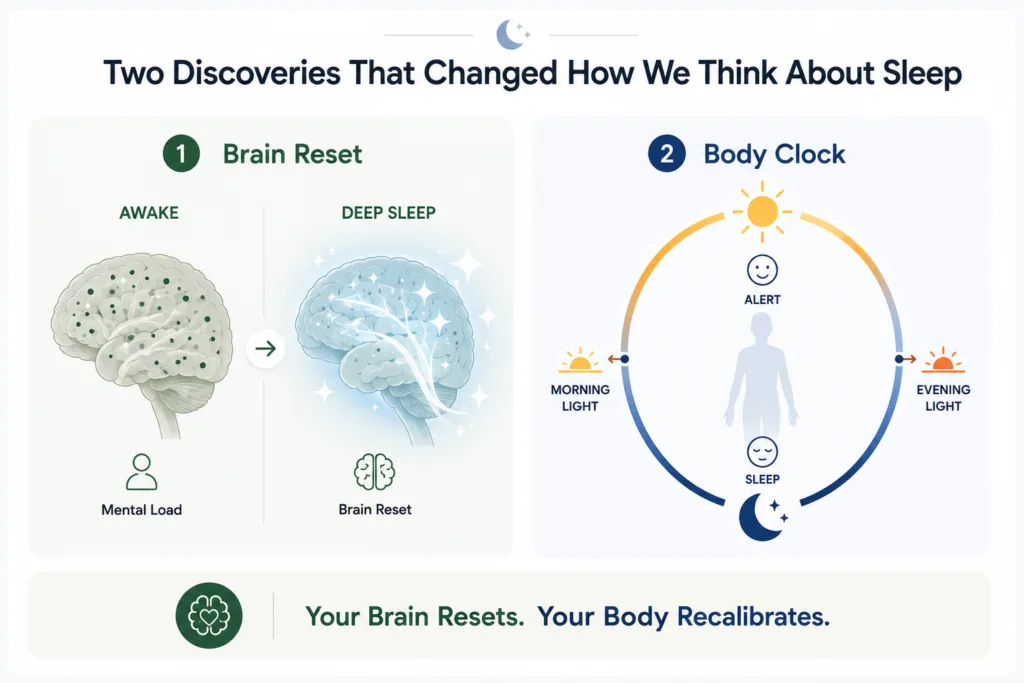
Here’s a way to think about it. Through the day, your brain accumulates waste – byproducts of all the thinking, processing, and decision-making. And while you sleep, it flushes all of that out.
That process is real. During deep sleep, the brain flushes out waste proteins that accumulate through the day – the same ones linked to memory loss and cognitive decline over time. When you cut sleep short, the cleaners don’t finish the job.
This landed differently than any wellness message ever had. It wasn’t “sleep more to feel better.” It was – your brain physically needs this to function properly. And it sent people straight to Google. Search interest in “deep sleep” overtook “how to fall asleep faster.” Products targeting sleep quality – not just duration – began pulling ahead. A whole new conversation started.
2.2 Your Body Has an Internal Clock – and Modern Life Is Breaking It
Every human runs on a roughly 24-hour biological cycle, driven primarily by light. Morning light tells the body to be alert. Evening light pushes sleep onset later and reduces the quality of rest you get.
A Stanford study showed that even repeated, marginal disruption to this rhythm is linked – at a population level – to significantly higher rates of cardiovascular disease and metabolic conditions.
This wasn’t a wellness influencer. It was Stanford, with data. That kind of credibility doesn’t just inform people – it motivates them to change behaviour.
In India, where family dinners run at 9pm and cricket matches go past midnight, this conversation is particularly sharp. Biology doesn’t negotiate with tradition.
3. The Books That Took It Mainstream
Science gave people the reason to care. But science alone doesn’t move culture. Two books did.
3.1 Why We Sleep – Matthew Walker (2017)
Walker, a neuroscientist at UC Berkeley, wrote what is effectively the founding text of the modern sleep conversation.
His central argument: sleep is not passive recovery – it is the most important health behaviour humans engage in. More important than diet. More important than exercise.
The book introduced millions to terms like REM sleep, sleep debt, and sleep hygiene – vocabulary that now appears routinely in search queries and product campaigns. Every sleep brand today is, in some way, selling into the cultural permission Walker created.
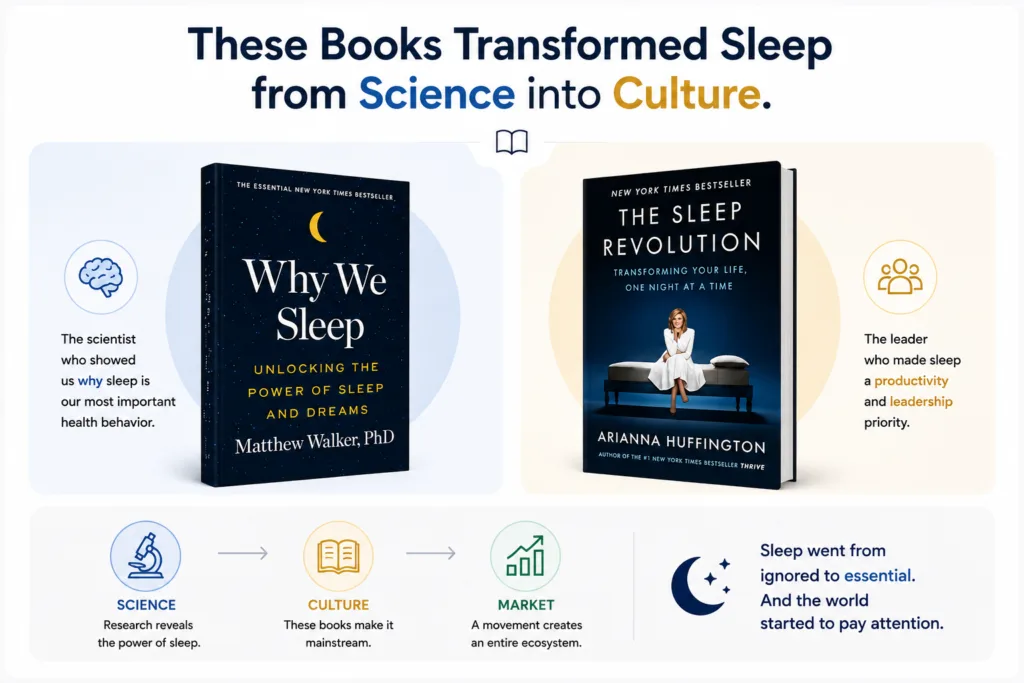
3.2 The Sleep Revolution – Arianna Huffington (2016)
If Walker was the scientist, Huffington was the translator.
After collapsing from sleep deprivation in 2007, she became one of the most prominent voices arguing that glorifying sleeplessness wasn’t just unhealthy – it was bad business.
“The way to do more, it turns out, is to first take care of yourself.” – Arianna Huffington, The Sleep Revolution
The book brought the conversation into boardrooms – giving leaders a framework to treat sleep as a productivity issue, not a personal weakness.
Together, these two books did something decades of medical advice couldn’t: they made prioritising sleep socially acceptable – even aspirational.
And once something becomes aspirational, a market forms around it.
4. Three Types of Products Defining the Sleep Economy
That market has taken shape fast. And when you look at everything that’s come out of it, the products break into three clear buckets -the ones that keep you awake, the ones that help you sleep, and the ones that help you track it.
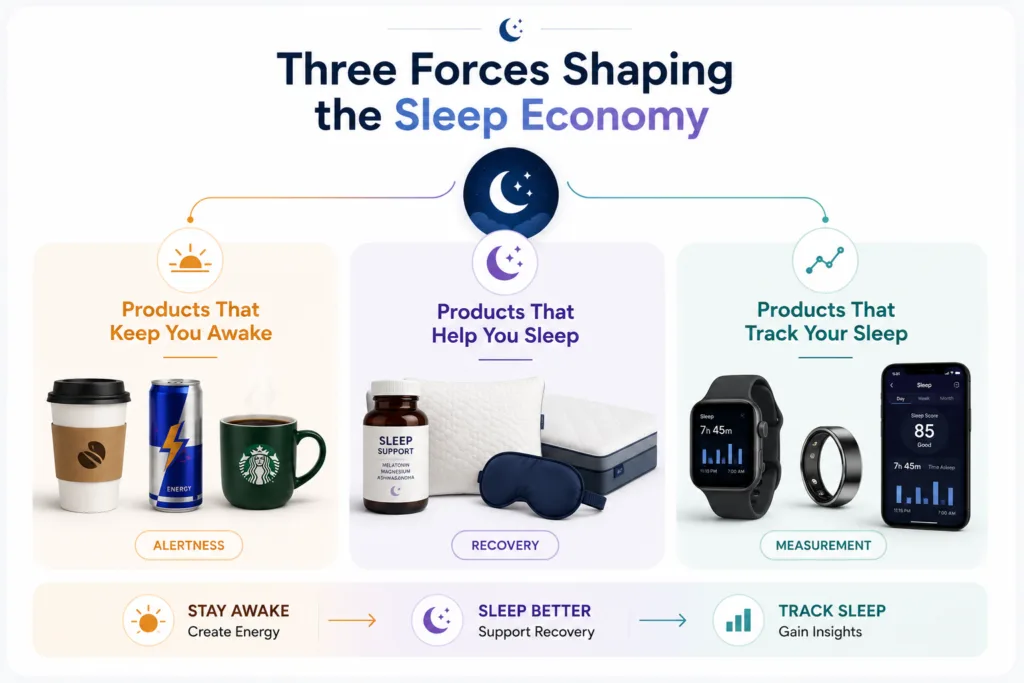
4.1 Products That Keep You Awake
Think coffee, energy drinks, and everything in between. Red Bull, Monster, Nescafé, Starbucks -these are billion-dollar brands built entirely on keeping people alert and awake. The energy drink market in India alone is growing at double digits year on year.
These aren’t the villains of the story. They serve a real need. But they sit on the opposite end of the sleep economy -and understanding them matters, because the same consumer reaching for a Red Bull at 3pm is often the one searching for a sleep supplement at midnight.
That tension is exactly what makes this space interesting.
4.2 Products That Help You Sleep
This is where most of the investment is going right now -and the category is bigger than most people realise.
Supplements have surged. Melatonin, magnesium, and ashwagandha are the most searched sleep ingredients in India. The India sleep supplement market grew 22.4% between 2023 and 2024 alone. Ashwagandha and Tagar -the Ayurvedic valerian root – carry a natural advantage here because Indian consumers already trust them.
Then there are the physical products. Duroflex, Wakefit and The Sleep Company have built significant scale around mattresses, pillows, and sleep environment products. And they are expanding aggressively offline now, because sleep is an experience people want to feel before they buy.
Sridhar Balakrishnan, Group CEO of Duroflex appeared on Dilse Omni Talks with host Saurabh Agrawal, where the conversation explored “What it really takes to modernise a legacy retail home furnishing brand without losing what made it great.”

On the more experimental end, the sleepmaxxing trend – over 100 million TikTok posts – has brought mouth tape, weighted blankets, and sleep bonnets from fringe to mainstream.
4.3 Products That Track Your Sleep
This is the fastest-growing segment in the entire sleep economy.
In 2026, wearable use for sleep tracking has surged to 53% of respondents globally – with smartwatches leading the way. And among those users, nearly 4 in 10 check their sleep data at least once a week. In India, Ultrahuman – a Bengaluru startup – has carved out a strong position with the Ultrahuman Ring Air, the lightest sleep tracker in the world at just 2.45g.
Beyond wearables, the next frontier is under-mattress sensors — devices that sit beneath your mattress and track your sleep without you wearing anything at all. Eight Sleep, for example, has raised $50 million to build AI that adjusts your mattress temperature before a disruption even happens. You don’t do anything. It just figures it out.
One thing worth flagging though – obsessive score-tracking has given rise to what doctors now call orthosomnia, where the anxiety of chasing a perfect sleep score actually makes sleep worse. The best products in this space will eventually stop asking you to check your scores and just quietly fix the problem for you.
5. Five Sleep Profiles – and What They Mean for Brands
Here’s something that most brands in this space aren’t paying attention to yet.
A study published in PLOS Biology – based on brain scans, lifestyle data, and sleep quality of over 770 adults – found that people don’t just sleep differently. They fall into five distinct profiles. And each profile is essentially a different consumer with a different problem, a different motivation, and a different product waiting to be sold to them.
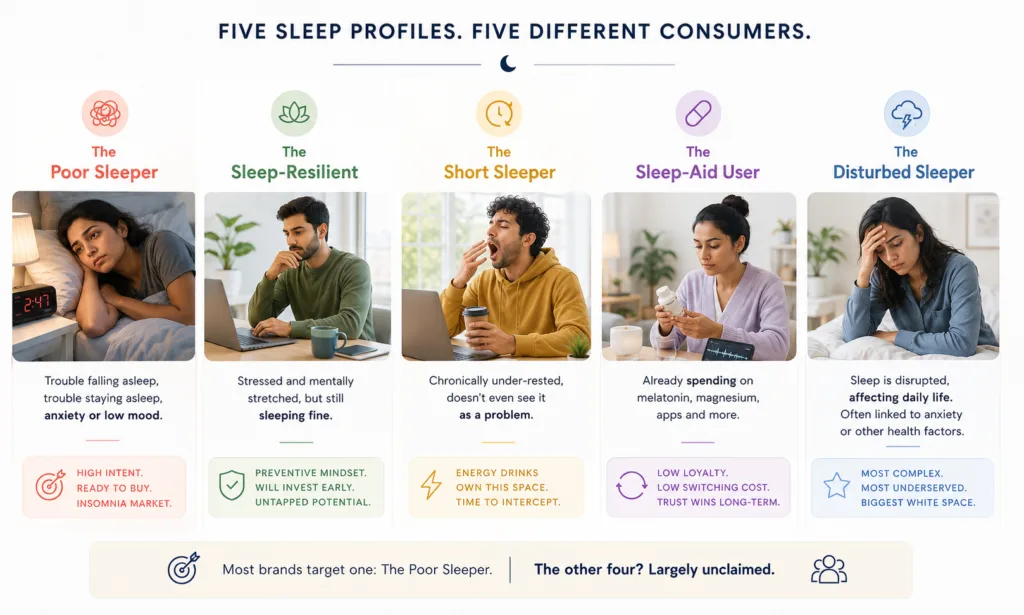
The Poor Sleeper – trouble falling asleep, trouble staying asleep, and usually carrying some anxiety or low mood underneath it all. This is the person every sleep brand is currently fighting to acquire. Most vocal, highest intent to buy, and willing to try almost anything. The insomnia market lives here.
The Sleep-Resilient – stressed, mentally stretched, but somehow still sleeping fine. Brands largely ignore this person because they don’t look like a customer yet. But this is the preventive health consumer – they’ll spend on tracking and maintaining their sleep before it becomes a problem. Huge untapped segment.
The Short Sleeper – chronically under-resting, often doesn’t even see it as a problem. This is who energy drink brands currently own. The opportunity for sleep brands is to intercept them – not with guilt, but with a compelling enough reason to care before the health consequences show up.
The Sleep-Aid User – already spending. Melatonin every night, magnesium on the shelf, maybe a white noise app running. But loyalty is low and switching cost is almost zero. Whoever builds genuine trust with this person – through consistency, results, or education – wins a customer for years.
The Disturbed Sleeper – the most complex and the most underserved. Sleep is disrupted enough to affect their daily functioning, often linked to anxiety or other health factors. No single product solves this cleanly. But that’s also what makes it the biggest white space in the entire category – the brand or platform that figures out a credible solution here will have very little competition.
The point isn’t that brands need to serve all five. It’s that most brands right now are targeting one profile – the Poor Sleeper – and leaving the other four largely unclaimed.
6. India’s Sleep Crisis – and the ₹30,000 Crore Opportunity
All of this is happening against a backdrop that makes India one of the most important markets in the global sleep economy.
India is the second most sleep-deprived nation in the world. Only Japan ranks worse.
60% of Indian adults are chronically under-rested. 94% of Indian workers have called in sick at least once due to poor sleep – the highest rate of any country surveyed globally. Sleep is now India’s biggest workplace mental health challenge – cited by 53% of employees, ahead of anxiety and burnout.
The market has responded. India’s sleep economy is valued at ₹30,000 crore. The sleep aid products market – covering mattresses, supplements, medication, and devices – is projected to nearly double by 2033. Search trends confirm the momentum, with searches around mattresses, sleep supplements, and sleep tracking all showing multi-year compound growth. Not viral spikes. The kind of steady accumulation that signals a category going mainstream.
The Takeaway
Sleep didn’t become a serious topic because of a marketing campaign.
It became one because the science got credible enough to worry people, the books made it accessible enough to reach everyone, and the data got personal enough – right there on your wrist every morning – to make ignoring it impossible.
The consumer has changed. More informed, more specific, and more willing to spend on something that actually speaks their language.
The brands that define this category will be the ones that understand why India isn’t sleeping – a metabolic, biological reality far more specific than “too much screen time” – and build their product and their story around that.
The science is settled. The market is moving.