



Think about the brands you use every day. There are some you absolutely love and keep going back to, some you like but can easily replace with another brand, and some you simply don’t care about. What makes us feel this way?
Often, it’s not just the product but the experience a brand gives us, how it makes us feel, how easy it makes things for us, and how it treats us as customers.
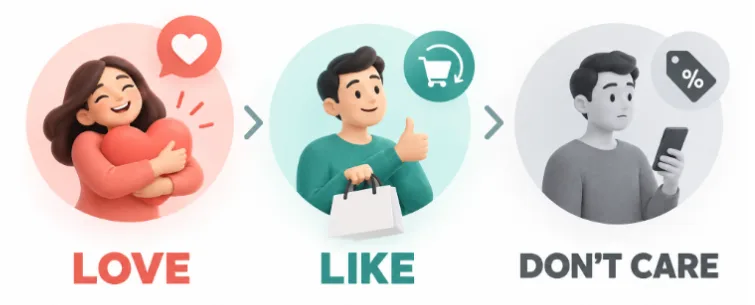
Now place those brands into three columns: Love, Like, and Don’t Care. You probably would not need much time to decide.
Some brands have earned a place in your routine and your identity. You would defend them even when someone points out a cheaper alternative. Others are perfectly acceptable, but you would switch if a better offer appeared. Then there are the brands you barely remember. You buy them because they are available, affordable, or convenient.
This distinction matters because repeat purchase is not the same as loyalty. A customer who buys from you five times may be buying out of habit, convenience, or a lack of alternatives. The more useful question is not only “How often do customers buy?” but also “Why do they stay, and what would make them leave?”
Three customer relationships
At DAiOM, the Love–Like–Don’t Care framework is a practical way to answer that question. It helps brands connect customer emotion with observable behaviour, and then decide what to improve.
To understand customer experience, we first need to understand how emotionally connected customers are to a brand.
1. Love: “I don’t want to replace this brand.”
Brand love is present when a cheaper alternative does not automatically feel like a better alternative.
The customer may value the product, but the relationship is usually larger than product specifications. It may include familiarity, trust, identity, service, community, convenience, or an ecosystem that becomes difficult to leave.
Apple is a useful example of this dynamic. For many customers, changing devices is not simply a matter of comparing phone prices. It can mean leaving an ecosystem of devices, services, habits, and experiences that already work together. The strength of the relationship shows up in behaviours such as repeat upgrades, trade-ins, cross-category adoption, direct purchases, advocacy, and willingness to pay a premium.

Amul Butter: People stick with Amul Butter out of habit and familiarity, even when cheaper options exist. But buying out of habit isn’t proof of true brand loyalty, to know if customers actually love it, you have to test whether they’d pay more, switch brands, or recommend it.
2. Like: “I’m happy with it, but I’m open to something else.”
This is where many successful brands operate.
The product works. The website is easy enough to use. Delivery is reasonably quick. Customer support solves most problems. The customer is satisfied, but not emotionally attached.
A 20% discount from a competitor, faster delivery, better availability, or a more attractive new collection may be enough to change the decision. Nothing is necessarily wrong with the brand. It simply has not created enough distinctive value to make staying feel important.
This is why repeat purchases should be read alongside switching and consideration data. A high purchase frequency with low preference, low advocacy, and high promotion dependence is closer to Like than Love.
3. Don’t Care: “Any decent alternative will do.”
In some categories, the customer is solving a functional need rather than expressing a brand preference. Tissues, notebooks, basic household products, or an immediately available bottle of water may be chosen with little emotional involvement.
In this position, price, availability, shelf placement, search ranking, and distribution do most of the work. If another brand is cheaper or easier to find, the customer has little reason to stay.
The opportunity is not to force brand theatre onto a low-involvement category. It is to identify the specific friction or unmet need that can create preference: more reliable quality, better availability, easier replenishment, a useful service, a credible purpose, or a noticeably better experience.
What should brands measure?
The three categories are not survey labels to be collected once a year. They are working segments that should connect perception data to behavioural data.
Many businesses say they are customer-centric. They send surveys, calculate NPS, monitor complaints and review dashboards.
Net Promoter Score, or NPS, asks customers how likely they are to recommend a company on a 0–10 scale.
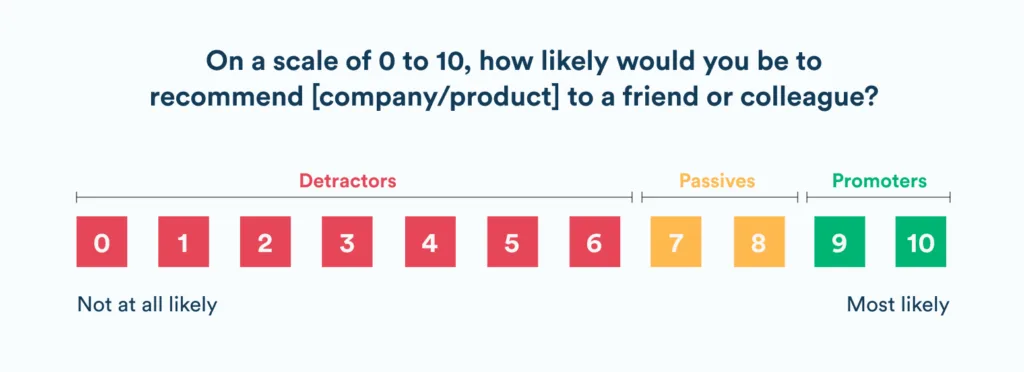
It can be useful as one signal of advocacy, but it should not be treated as a complete measure of brand love. A score becomes more useful when it is linked to the customer’s reason, segment, journey stage, purchase history, and later behaviour.
But listening is only the first half of the customer experience. Acting is the other half.
If a customer reports a recurring problem, what happens next?
- Is the feedback visible to the right team?
- Does someone own the resolution?
- How quickly does the organisation act?
- Does the customer see that anything changed?
A culture of customer experience requires more than a CX department. It requires product, marketing, sales, technology, operations, stores and service to take shared responsibility.
It means empowering people to solve problems, removing unnecessary approvals, measuring time to resolution and learning from patterns rather than handling every complaint as an isolated ticket.
Customer admiration is earned when a brand listens, responds promptly and gets better because of what it hears.
How leading brands turn loyalty into measurable behaviour
“The greatest stories of brands are not told by the brands themselves. They are told by their customers.”
- Starbucks: loyalty is measured through frequency, spend, and personalisation
Starbucks provides a clear example of a brand connecting a loyalty programme to business outcomes. In January 2026, the company said Starbucks Rewards had reached more than 35 million 90-day active members, and that Rewards members drove nearly 60% of U.S. company-operated revenue in fiscal 2025, representing more than $13 billion in spend.
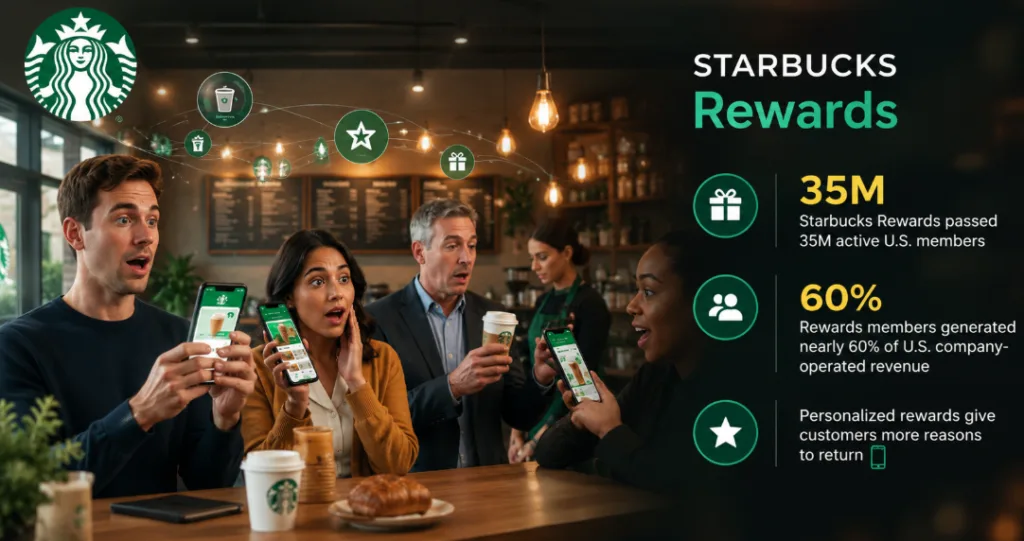
Those measures go beyond membership count. Active members show current engagement. Member revenue shows commercial contribution. The programme also gives Starbucks behavioural signals such as visit frequency, offer response, product preferences, reward redemption, and movement between membership levels.
The lesson for other brands is simple: do not measure a loyalty programme by registrations alone. Measure active participation, frequency, incremental spend, retention, redemption economics, and whether personalisation increases value without creating unnecessary discount dependence.
- Taj: membership can connect preference across the full experience
Taj InnerCircle, now part of the Taj–NeuPass loyalty programme, is designed to work across stays, dining, spas, and other experiences. The programme offers member rates, room upgrades, early check-in and late check-out, and the ability to earn and redeem NeuCoins across participating services.

That structure creates a broader measurement opportunity. Taj can look at member versus non-member booking frequency, direct-booking share, repeat stays, cross-category usage, redemption, upgrade uptake, and the value of members over time. A guest who books a room, returns for dining, uses the spa, and chooses the brand for a future trip is showing a deeper relationship than a one-time discounted booking.
For hospitality brands, the most important metric may not be occupancy alone. It may be the share of the guest’s travel and lifestyle wallet that the brand earns.
- American Express: service and ecosystem are part of the product
American Express describes itself as a payments and premium lifestyle brand. Its public customer proposition combines service, rewards, travel, partnerships, digital tools, and other member experiences. The company also highlights customer-satisfaction recognition and the role of personalised digital experiences in deepening relationships.
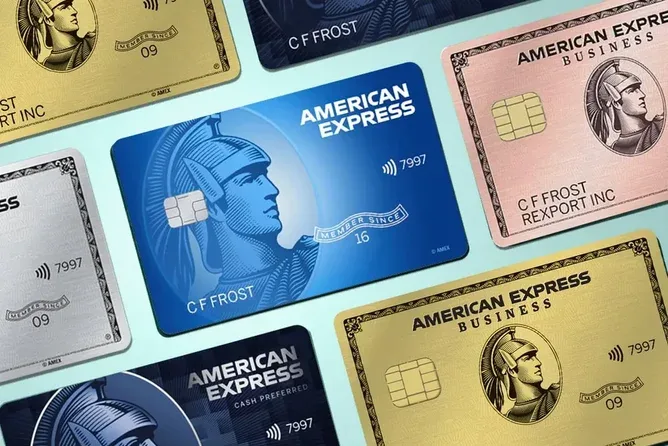
The measurement implication is important. A premium brand should not evaluate loyalty only through transaction volume. It should examine retention, spend per active member, product holding, usage of benefits, engagement with partner experiences, service recovery, and willingness to pay for membership or premium products.
In other words, the experience is not an extra layer added after the product. The experience is part of the product’s value.
- Patagonia: purpose needs behavioural proof, not just campaign reach
Patagonia’s Worn Wear initiative encourages repair, reuse, and the purchase of used Patagonia products. Its broader impact reporting also makes the company more transparent about environmental progress and unfinished work.

A purpose-led brand can measure more than impressions. It can track repairs, trade-ins, resale participation, product longevity, repeat engagement with the community, participation in activism or events, sentiment, and whether customers associate the brand with the values it claims to represent.
The important discipline is to separate attention from alignment. A campaign may generate views, but a stronger signal is whether customers understand the brand’s point of view, act on it, choose the brand because of it, and remain engaged when there is no immediate promotion.
- Dove: emotional connection can be tested through brand meaning
Dove’s Real Beauty platform has consistently focused on beauty standards, confidence, and representation rather than communicating only functional product benefits. The brand continues to publish research and insights about beauty perceptions and confidence.
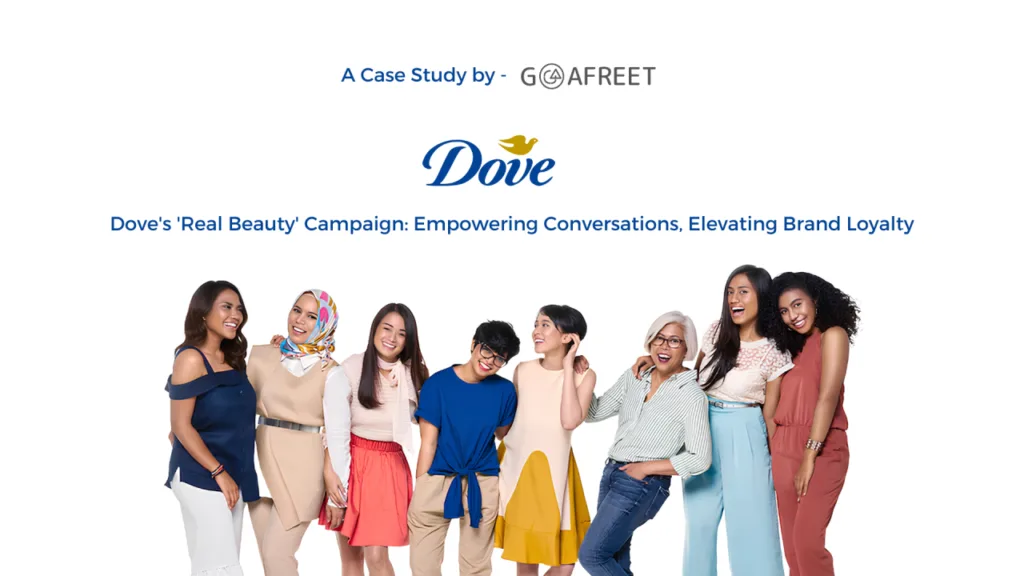
For a purpose-led campaign, useful measures include aided and unaided awareness, message association, perceived authenticity, emotional response, consideration, search and social conversation, and changes in purchase intent. The crucial question is whether the campaign changes what the brand means to people, not only whether it creates a temporary spike in reach.
Moving customers from Don’t Care to Like to Love
Here’s where I think the framework becomes particularly useful for businesses.
These aren’t permanent customer categories. A customer can move from Don’t Care to Like, from Like to Love, and unfortunately, from Love straight to Don’t Care if the brand repeatedly disappoints them.
But moving between these stages requires different approaches and strategies.

Don’t Care → Like: earn the right to be chosen
At this stage, focus on what works, not what looks impressive. The product should deliver what it promises. The price should make sense. The brand should be available when customers need it. Information should be easy to find, checkout should be straightforward, and support should not create unnecessary work.
Measure the basics: conversion, availability, delivery reliability, product quality, customer effort, complaint rate, and first-contact resolution. If these are weak, emotional campaigns will not compensate for the underlying experience.
Like → Love: create reasons to stay
A good product and a smooth checkout can create satisfaction. Emotional attachment usually requires something more distinctive: a brand that remembers relevant preferences, resolves a problem without making the customer repeat their story, acts on feedback, or gives customers a reason to identify with its values.
Measure this transition through preference, advocacy, price resilience, share of wallet, cross-category adoption, voluntary referrals, and the gap between customers who say they are loyal and customers who actually remain loyal when conditions change.
Love → Don’t Care: protect the relationship when something goes wrong
Customers do not expect perfection. They do notice whether a brand takes responsibility.
Track complaint recovery time, repeat complaints, post-resolution satisfaction, churn after service failure, compensation effectiveness, and whether the customer returns after the issue is resolved. A recovery experience can strengthen trust; an ignored problem can erase years of brand-building.
Omnichannel is where the relationship becomes real
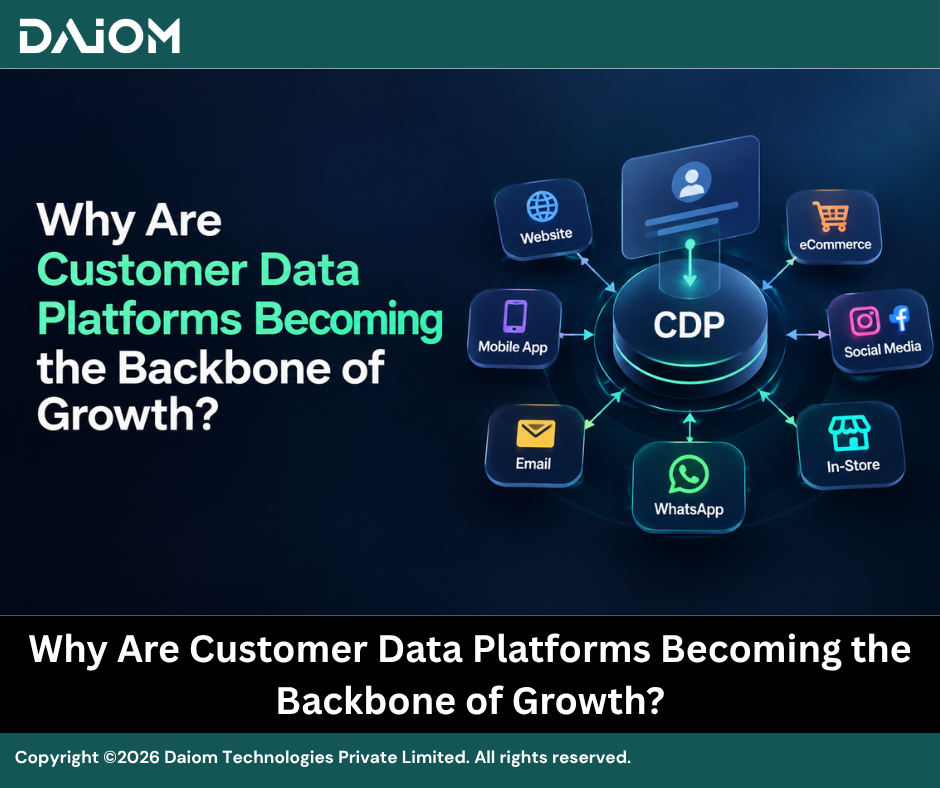
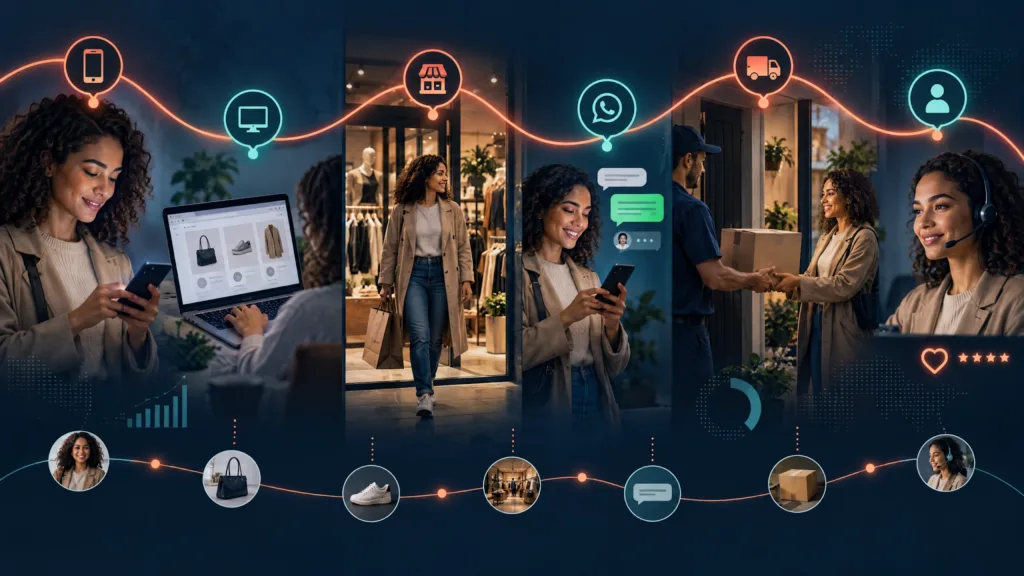
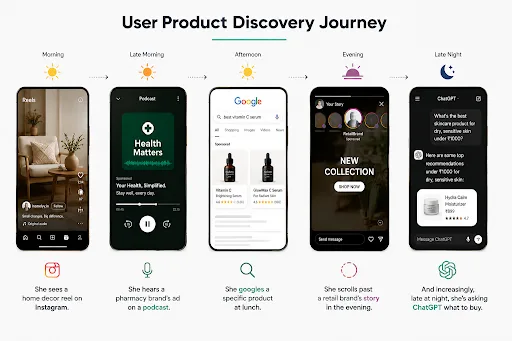
A customer’s relationship with a brand is not built on one platform. They may discover a product on Instagram, read reviews on a website, visit a store, purchase through an app, receive an update on WhatsApp, and contact support after delivery.
If those interactions are disconnected, the customer experiences the brand as careless. They receive an offer for something they already bought. They explain the same problem to multiple agents. The store cannot see the online order. The website does not recognise previous interactions.
A connected experience should make it easy to move between channels without starting over. The measurement system should therefore include cross-channel conversion, identity match rate, journey completion, repeat contact, resolution time, personalisation relevance, and customer effort by channel.
The goal is not to be present everywhere. The goal is to make the brand feel coherent wherever the customer meets it.
Two exercises for leadership teams
1. Build your own Love–Like–Don’t Care map
Choose five categories such as food, fashion, hotels, electronics, and banking. List the brands that immediately come to mind in each column.
Then ask: Why is one brand loved while another is merely liked? What would make you switch? Is your preference driven by product quality, convenience, price, trust, identity, or an experience worth talking about?
2. Compare what customers say with what they do
Ask your team where customers would place your brand. Then compare the answer with actual evidence:
•Are repeat purchases driven by preference or promotions?
•Do customers buy more categories from you over time?
•What happens to retention after a service failure?
•Do customers recommend the brand without an incentive?
•Can customers move between channels without repeating themselves?
•Do your dashboards show actions taken after feedback is received?
The objective is not to produce a flattering label. It is to identify the next experience that can move a customer one step closer to preference.
The question that matters most
Advertising can make people notice a brand. Discounts can get them to try it. Distribution can make it easy to buy. None of these guarantees that customers will care.
That takes consistency, trust, convenience, distinctiveness, and the ability to deliver on promises, especially when something goes wrong.
At DAiOM, we work at the intersection of data, AI, digital marketing, and customer experience to help brands build connected omnichannel growth.
The objective is not simply to reach customers across channels. It is to give them more reasons to stay, return, and recommend.
So ask a simpler question than “How many customers purchased from us?”
How many customers would genuinely miss us if we disappeared tomorrow?
That may be the difference between having customers and building a brand people actually care about.
Your turn: Pick a category—food, fashion, hotels, airlines, or banking. Which brands do you Love, Like, or Don’t Care about? What made you put them there?