




Google leads the global search engine market with over 90% of the total search volume, far ahead of Bing, Yahoo and other competitors.
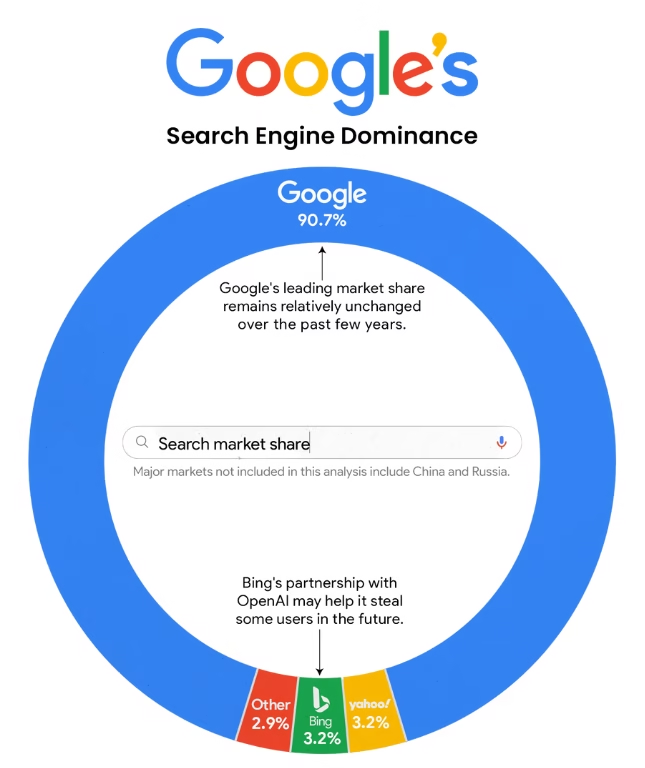
But over the past year, new AI tools like Perplexity and ChatGPT have started changing how people search by offering conversational and more personalized answers.
In response, Google has been testing features like Search Overviews, which have already caused a small shift in user behavior—about 1–2%.
At the recent Google I/O 2025 event, Google announced major updates that go beyond the traditional keyword-and-link model. These changes are designed to make search more visual, more interactive, and more helpful—highlighting a major shift in how we explore and find information online.
Read more – Highlights From Google I/O ’25 Keynote Event: Transforming Search, Shopping, Innovation, & AI

From AI Overviews to a full-fledged AI Mode, here’s how Search is transforming, what it means for users, and why it marks one of the biggest shifts in internet history.
“AI is one of the most profound things we’re working on as humanity. It’s more profound than fire or electricity.”
Sundar Pichai (CEO, Google)
1. The Rise of AI Overviews
Google launched AI Overviews last year, and it’s already changing how people use Search.
Read more – How Is AI Changing The Way We Search?
Instead of just showing a list of links, AI Overviews give you a quick summary at the top of your results. These summaries are powered by AI. They pull key information from across trusted websites and give you one clear, helpful answer — all in one place. So, you don’t need to click on 5 different links to figure something out. You get what you need, faster.

Moreover, this has had a big impact:
- In countries like the U.S. and India, AI Overviews led to a 10% increase in how often people use Google for more complex questions.
- People are now asking longer, more detailed, and even visual questions (like combining text with images).
- Most importantly, users are more satisfied with their results. They’re finding what they need quickly and coming back to search more often.
2. AI Mode
While AI Overviews are great for quick answers, some users — especially those who want to go deeper — need more. That’s where AI Mode comes in.
AI Mode is the most powerful version of Google Search yet. It’s now rolling out to users in the U.S. and brings a much smarter, more interactive experience.

Here’s what makes it unique:
- Talk to Search: You can chat with Search, just like a conversation. Ask a question, get a response, then ask follow-ups — through text or even voice.
- Mix and match inputs: AI Mode supports multimodal input, which means you can combine text, images, and more in one query.
Smarter and faster answers: AI Mode uses something called “query fan-out.” This means it breaks your question into smaller parts and searches for all of them at once. So you get deeper, more complete answers — fast.
2.1 AI-Powered Shopping
Shopping online takes time — comparing products, checking reviews, finding the right fit. AI Mode is here to simplify it all.
Read more – Highlights From Google I/O ’25 Keynote Event: Transforming Search, Shopping, Innovation, & AI

Google combines the power of Gemini’s smart thinking with its huge product database, called the Shopping Graph, to create a better shopping experience.

Here’s what you can do:
- Ask Search directly: “Best hiking shoes under ₹5000” or “Show me casual shirts for office wear.”
- Try before you buy: Just upload one photo of yourself and virtually try on clothes — see how they’ll look!
- Smooth checkout: Like something? Use Google Pay right there to buy it — fast and easy.
Soon, AI Mode will be able to give you results based on your personal context—if you choose to turn it on.
For example, if you search “Things to do in Nashville this weekend with friends — we’re big foodies who like music,” it can use your past restaurant searches, check Gmail for your flight or hotel confirmations, and suggest events or places to eat near where you’re staying.
3. Deep Search in AI Mode
Sometimes, users don’t just need a quick answer, all they need is a full, detailed report. That’s what Deep Search in AI Mode is for.

Let’s say you’re trying to learn about electric car trends. Normally, you’d search many times, read lots of articles, and take notes. Deep Search does all that for you.
It runs hundreds of searches in the background and gives you a full report with sources, key facts, and even new ideas you may not think of.
It’s perfect for deep topics like research, market studies, or comparing companies—and it saves you a lot of time.
4. Live capabilities in Search, for real-time help
Google is now moving beyond typing or even speaking to search—you can literally start searching with your eyes. Google’s Search Live, powered by Project Astra, allows you to point your phone camera at something and have a real-time conversation with AI about it.

For example:
- Point your camera at a math problem and ask for step-by-step guidance.
- Show it a science project and ask what’s wrong or how to improve it.
- Scan a broken appliance and ask how to fix it.
This is truly multimodal search in action—combining voice, vision, and context to create real-time, useful help. Over 1.5 billion people already use Google Lens monthly. Live Search builds on that familiarity with deeper interaction and smarter responses.
5. Agentic Capabilities in AI Mode
Google is introducing agentic capabilities to AI Mode, based on Project Mariner. It works like let’s say you’re trying to book event tickets or find a restaurant reservation.
Just ask Search: “Find 2 affordable tickets for this Saturday’s Reds game in the lower level.”
Search will:
- Crawl through different ticket platforms in real time
- Compare prices, availability, and seating options
- Present the best choices
You still choose the final step, but Search does the main work. This feature will soon include restaurant bookings and local appointments through integrations with partners like Ticketmaster, StubHub, Resy, and Vagaro.
6. Visualizing Information Through Custom Charts and Graphs
Understanding data becomes much simpler when you can actually see it. That’s why Google’s AI Mode now brings data visualization into Search.
Read more – Top Data Visualization Tools: A Complete Overview
If you ask something like, “Compare home field advantage stats between the Yankees and Red Sox,” Google won’t just give you a text answer. It will pull live data from trusted sources, turn it into interactive charts and graphs, and show it in a clear, visual way.

You get the insights you need—faster and easier. This feature starts with sports and finance searches, and will expand to more topics soon.
“Search is changing. We’re moving from ‘strings to things’ and now from ‘things to understanding’—thanks to AI.”
Danny Sullivan (Google’s Search Liaison)
7. Conclusion
From instant AI Overviews to personalized suggestions, smarter shopping, and even visual summaries, the way we search is evolving fast.
But while the demos and promises look impressive, it’s still early days. A lot can seem exciting in a keynote video—but the real test is how it performs in everyday use.
The future of Search may be here, but whether it truly delivers value at scale is something only time—and real users—will tell.
Also Read – Highlights From Google I/O ’25 Keynote Event: Transforming Search, Shopping, Innovation, & AI