
Out of a global population of 8.3 billion, over 5.6 billion people are active on social media with the average user spends ~3.5 hours a day on these platforms.

Social media isn’t just another marketing channel anymore. It’s the new TV.

As digital marketing scaled, over 70% of marketing spends moved online. First, online started influencing sales. Then it started shaping brand preference.
Today, it influences omnichannel behaviour, what people research, where they buy, and whether they walk into a store at all.

And yet, if you’ve worked in marketing long enough, you’ve probably heard some version of this in a meeting:

“We should do more on social media. Let’s go viral, drive sales, send people to stores… you know, all of it.”

In theory, social media is expected to do everything, build brand, acquire customers, drive repeat purchases, and push store walk-ins.
In reality, most brands are still posting pretty content and hoping the numbers follow.

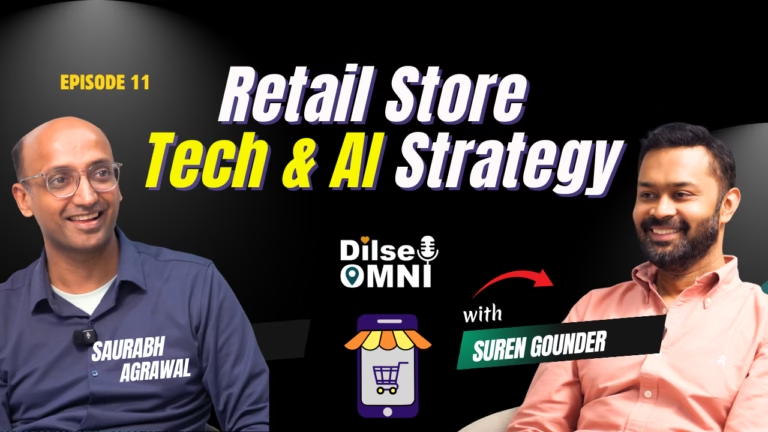
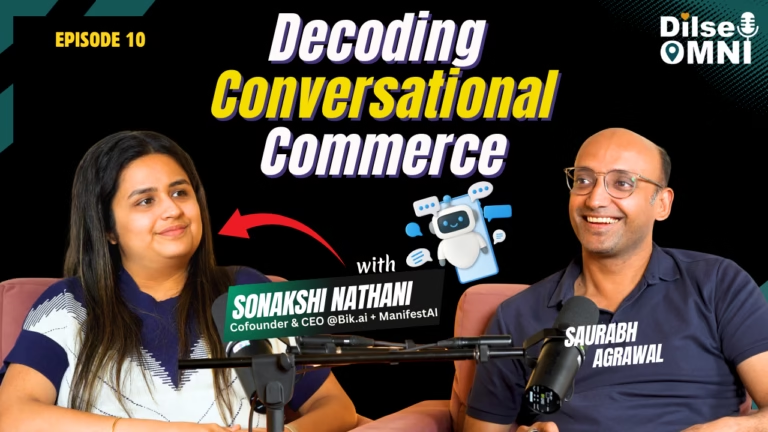
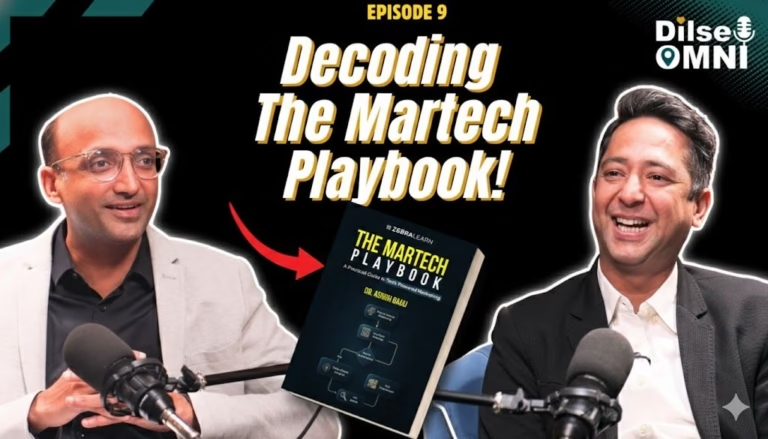
That gap is exactly what this episode of DilSe Omni Talks explores.

Saurabh sits down with Sasha, a marketing strategist and Head of Marketing (ex-Lenskart, Good Glamm Group), who has lived social media across every phase, from early platform days in beauty, fashion, eyewear and D2C scale-ups to omnichannel brands, and now real estate.

This episode unpacks how social media actually drives real business outcomes when you stop chasing vanity metrics and start designing for omnichannel growth.

From “Airtel Girl” to a third life on social media

Saurabh admits that when he asked an AI tool to write an intro for Sasha, it confidently told him she was the Airtel 4G girl.

But that mix‑up is exactly where her first social media life began.

Years after the Airtel campaign, people began confusing the Airtel girl with Sasha, and her personal Instagram account was soon flooded with follow requests from users who believed she was the face from the ad.

At the time, Instagram was still “filters and fun,” social media was just picking up, and brands were being convinced to even be online. Sasha did what any curious person would do:

  • She switched her private account to public
  • Woke up to thousands of followers
  • And accidentally started her first social journey as a public persona

That audience worked for her in the early career phase: fashion, events, high‑energy work.

Post‑COVID, her content became deeply personal. So she rebuilt from scratch with people who actually cared about her life and work.

And that sets the tone for the whole conversation: growth at all costs is not the goal; the right audience and the right context are.​

Real estate vs D2C: How marketing is evolving?

One of the most interesting parts of the conversation is Sasha’s take on real estate storytelling versus D2C.

She’s witnessed this shift across luxury & lifestyle, beauty, and the content-to-commerce wave at POPxo and Good Glamm Group.

Industries keep changing. Platforms keep changing. Algorithms keep changing. People don’t.
Sasha Chhetri
Marketing Strategist, Head of Marketing (Ex: Lenskart, Good Glamm Group)

D2C teams are used to live in the fast lane:

  • Trending audios
  • Hooks in the first 3 seconds
  • Hard CTAs: “Buy now, use my code, sale ends tonight”

In real estate, it’s trust and convenience—“Will I really give my life savings to this brand?”

Sasha explains that in real estate, you’re asking someone to spend crores, sometimes on something that hasn’t even been built yet. The sales cycle is 3–6 months at best. In that world, your content playbook looks very different:

  • Slow, deep content that is easy to understand even for an older, non‑digital‑native audience
  • Repetition of core messages, because trust is built when people hear the same truth many times, not a new gimmick every day
  • Clarity over cleverness, you’re answering, “Can I trust you with my money?” not “Can you make me laugh?”

Sasha’s phrase is simple: “Slow and deep.”

If you sell ₹499 tees, chase trends. If you sell ₹5 crore villas, chase trust.

How to drive traffic to stores via social media?

Most brands still use social in one of two ways:

  1. Drive traffic to the website/app
  2. Drive awareness and hope everything else sorts itself out

But in true omnichannel categories: jewellery, high‑value retail, real estate, eyewear, you need people in physical stores.

Sasha’s offline playbook is refreshingly practical:

1. Geo‑targeting

Showing “visit our store” content to someone four hours away is pointless.

If your goal is footfall, your targeting has to be sharp: only people for whom the visit is actually realistic.

2. Show the experience you want them to have

Don’t shoot your beautiful jewellery or sofas in a neutral studio and then expect store visits.

“Your store is your studio.”

Shoot:

  • In the actual store

  • With real try‑ons

  • With real experts (stylists, optometrists, counsellors)

  • With real services (free eye tests, pillow exchanges, styling consults, etc.)

You’re not just pushing a product; you’re selling the feeling of walking into that space.

Read More: Footfall Blog

3. Go hyperlocal with creators (and employees)

If you’re trying to drive walk‑ins to a store in Ahmedabad, your creator should be from Ahmedabad.

Not a big‑city celebrity dubbed into Gujarati. Not a Jaipur influencer repurposed for Gujarat. Someone who lives there, sounds like there, and has credibility there.

Saurabh adds another sharp point: employees themselves are often your best hyperlocal creators, store staff who understand the product, the neighbourhood, and the customer.

Sasha loves that idea, with one guardrail: before you unleash 100 internal creators, influencers, your brand’s success metrics must be crystal clear and along with that the selection of influencers category must be analysed properly. 

Otherwise, your brand voice fragments overnight.

Accept that one campaign cannot do it all

  • You will need different creators and formats for different goals
  • An influencer who is brilliant at conversions may only have 1,000 followers
  • A mega‑influencer may be great for top‑of‑funnel buzz but terrible for ROAS

Vanity Metrics vs Metrics That Actually Grow the Business

Many brands confuse visibility with impact. Likes, views, and reach are great for awareness, but they don’t always translate into real growth. That’s where the difference lies: vanity metrics tell you how many people saw your campaign, while business metrics tell you whether it actually moved the needle.

The problem starts when brands expect sales or leads from campaigns designed only for attention. Growth-focused campaigns need one clear goal: conversions, qualified leads, or users entering your funnel, and success should be measured only against that. When the metric is clear, social media stops being “noise” and starts becoming a real growth channel.

Sasha’s advice: go deep into engagement, fit, and historic performance, even if it means saying no to people with “impressive” numbers.

Where focus goes, energy flows. If you aim your energy at vanity metrics, you’ll end up doing vanity work.

How to Connect Social Media to Business Results?

Sasha keeps social reporting simple and outcome-driven. Instead of talking about “good reels,” she draws a clear line from social to business impact: 

  1. Awareness (reach and views), 
  2. Intent (traffic to website/app and CRM leads), 
  3. Conversion (what happened to sales while the campaign was live). 

Showing time-based spikes in traffic or revenue during social pushes often makes the case instantly.

She then adds context with comments, DMs, UGC, and real customer messages. When numbers are paired with customer voices, social stops feeling like a vanity channel and starts looking like a real growth driver.

How is the CMO role changing?

Today, the CMO role is no longer about managing campaigns or agencies, it’s about scale, speed, and specialization.

At a macro level, the role is splitting into two key responsibilities:

A. Content Marketing Leaders: Focus on organic growth, social media, and content creation.

B. Data-Driven Growth Marketing: Specialize in performance and data analytics to drive sales and growth.

This might be the most important takeaway for anyone in their mid‑career.

Sasha stated: 

“The CMO role as we knew it doesn’t exist anymore. It’s no longer a skillset role. It’s a mindset role.”

The future CMO will not be someone who learned marketing only through campaigns, or agencies. They will be someone who has created content themselves first, posting, writing, or recording, before scaling it with teams, tools, and budgets.

Advice for Future Marketing Leaders

When asked how mid-level marketers can grow into future CMOs or growth leaders, Sasha keeps it simple. She doesn’t talk about tools or hacks. 

Her focus is on mindset: adapt quickly, drop the ego, stay curious, and keep learning.

  • Adaptability: When the market changes every quarter, sticking to “how it’s always been done” is the fastest way to become irrelevant.
  • Drop the ego: Real leadership comes from collaborating and using everyone’s strengths, not fighting over roles or credit.
  • Read deeply: Skimming content gives ideas, but deep reading builds the judgment to apply those ideas correctly.

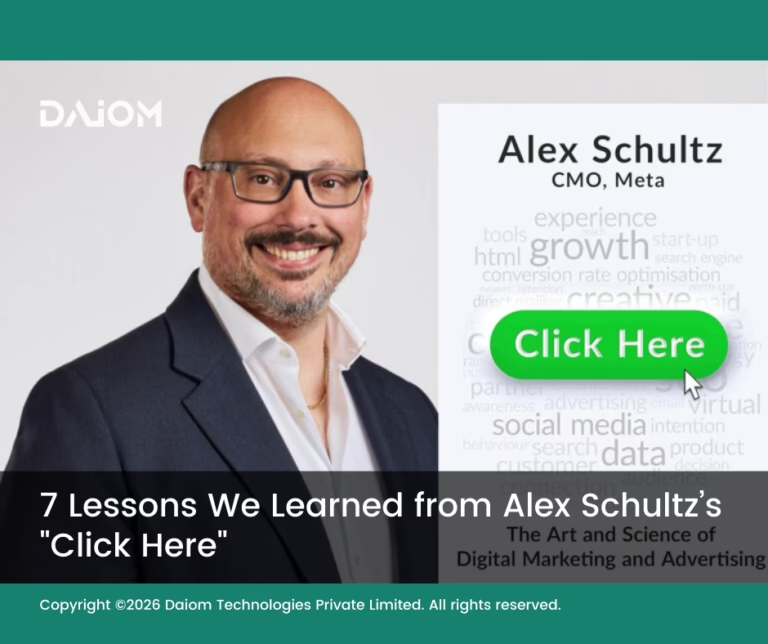
Saurabh agreed and also gifted her Click Here: The Art and Science of Digital Marketing by Meta’s CMO.

A book that perfectly blends analytics with storytelling. It’s a timely reminder for marketers and CMOs that growth today needs both data-driven thinking and creative perspective, not one without the other.

If you zoom out, this Dilse Omni episode is less about “tips for Instagram” and more about how to think about social as a serious growth lever:

  • Start from people and emotions, not formats and trends
  • Respect category and context—fast hooks for fast fashion, slow depth for real estate
  • Use social to drive real‑world behaviours: trials, store visits, CRM entry, repeat
  • Get brutally clear on success metrics before campaigns, especially with influencers
  • Draw a straight line from social to revenue with numbers and conversations
  • As a leader, focus less on mastering every tool and more on mindset, adaptability, and team building

When you’re genuinely curious, playful, and human in how you show up online, your customer feels it. And in a noisy, algorithm‑ridden world, that may be the biggest differentiator left.

Watch the full podcast to hear more about the journey!

If you’d like to discuss how we can help enhance and optimize your Omnichannel and growth marketing strategies, we’d be happy to set up a consultation call. Feel free to reach out to us at alibha@daiom.in

For more informative content and blog, follow and stay tuned to DAiOM.

Subscribe to our NEWSLETTER!

Section Title

5 Key Insights We Learned from the Digital Advertising Report 2026

Learn how digital, retail media, and AI are transforming India’s digital advertising landscape in...

How Social Media Actually Drives Omnichannel Growth?

How social media drives real omnichannel growth beyond vanity metrics. Learn how content influences...

Omnichannel Play in the Home Furnishing Industry

India’s home furnishing industry is growing fast. Discover key trends, pain points, and how brands...

How is the Role of CMO Changing?

The CMO role is evolving, from brand-only to growth and content leadership. Learn what’s changing...

Can India’s Retail Revolution Redefine Shopping?

India’s $1.6T retail revolution blends local shops, brands, and D2C with omnichannel in retail...

13 Key Consumer Trends Shaping 2030

India’s consumer is changing fast. Learn the 13 key trends shaping consumption by 2030 and what...

How Does An App Bring Incremental Value to a Brand?

Should your brand build an app? Explore when apps drive higher conversions, retention, and growth...

Omnichannel Transformation of the Legacy Home Furnishing Brand – Duroflex

Know how Duroflex transformed from a legacy mattress brand into an omnichannel leader by blending...

DilSe Omni Talks E6: Mastering Omnichannel Disruptions

From D2C to omni-channel scale, K. Ganesh shares insider lessons on disruption, data, and building...

Feel free to reach out to us for mapping out your social media strategies.

Leave a Reply

Your email address will not be published. Required fields are marked *

This field is required.

This field is required.

Please fill out the form to submit your enquiries